

 English
 Deutsch
 Español
 русский

Home · News · Industry News · Toolless Plug vs Traditional RJ45 Connector: Which Termination Is Right?
Industry News
Toolless Plug vs Traditional RJ45 Connector: Which Termination Is Right?
2026-08-14Content
- 1 Toolless Plug vs Traditional Connector: The Bottom Line
- 2 What We Are Comparing: Toolless Plugs vs Traditional Connectors
- 3 Key Differences at a Glance
- 4 Installation Speed and Total Cost: Where Toolless Plugs Pull Ahead
- 5 Performance, Reliability, and Environmental Fit
- 6 How to Choose the Right Termination for Your Job
- 7 Frequently Asked Questions
- 8 Final Recommendation
Toolless Plug vs Traditional Connector: The Bottom Line
You are standing in a cramped server room with a 48-port panel to terminate, a spool of Cat6A, and a crimping tool that has seen better days. Strip the jacket, untwist one turn, line up eight conductors, push, squeeze. The tester flags pair three, so you cut it off and start again. That is the reality behind the toolless plug vs traditional connector question.
The conclusion up front: toolless plugs are not universally better than traditional crimp connectors. But for field installation, small batches, and Cat6A or higher, toolless termination wins on speed, consistency, and rework rate. Traditional connectors still belong on the production bench, where tools are calibrated and operators are trained. Pick based on where and how you terminate, not on component price alone.
What We Are Comparing: Toolless Plugs vs Traditional Connectors
Traditional Crimp-Style RJ45 Connectors
A traditional RJ45 connector is terminated by inserting a prepared cable into the plug body and compressing the assembly with a crimping tool. The die pushes eight metal contacts through the insulation and into the copper conductors, while the rear body clamps the jacket for strain relief. Done correctly, it is a proven and inexpensive connection; done badly, it produces intermittent opens, excess crosstalk, or a broken latch.
Toolless RJ45 Field-Termination Plugs
A toolless plug, also called a field-termination or IDC-style plug, replaces the crimp die with a cap or lever. The installer arranges the conductors by color code into channels on the plug body, then closes the cap. Each contact cuts through the insulation to make a gas-tight connection, and the housing itself provides strain relief. The whole operation takes seconds rather than minutes.
For example, BTBL's Cat6 unshielded toolless RJ45 connector with wings uses a snap-down cap that locks each conductor into position, so there is no die to misalign and no contact block to push out of square. If you want the mechanical details, our overview of the structural characteristics and application advantages of toolless plugs walks through the contact design and termination sequence.
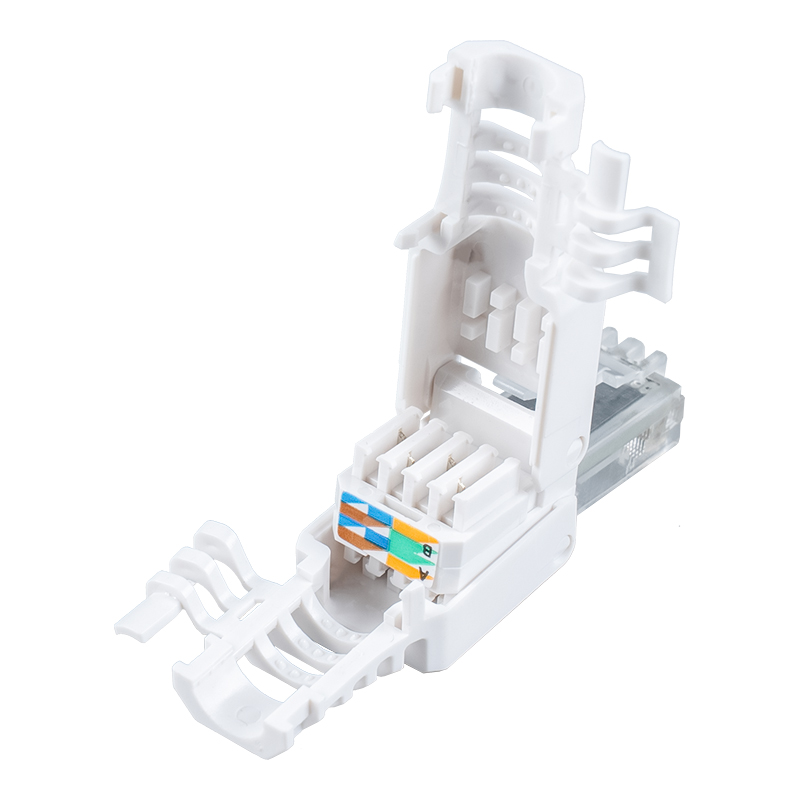 Cat6 Unshielded Toolless RJ45 Connector (with wings) RJ-688X-C6 Supplier, FactorNingbo Betterbell Telecommunication is a China Cat6 Unshielded Toolless RJ45 Connector (with wings) RJ-688X-C6 supplier and factory, offe...View Product →
Key Differences at a Glance
Here is what changes when you swap a crimp connector for a toolless plug.
| Factor | Traditional crimp connector | Toolless RJ45 plug |
|---|---|---|
| Tools required | Crimping tool, cable stripper, sometimes a tester | Cable stripper or snips; no crimp die |
| Typical time per end | 4-6 minutes including rework risk | 1-2 minutes including rework risk |
| Skill sensitivity | High; wire order, untwist length, and insertion depth all matter | Moderate; color order still matters, but channels guide alignment |
| Rework | Cut off and start again with a new plug | Several designs allow reopening and re-terminating the same plug |
| Performance consistency | Depends on operator technique and tool calibration | More consistent due to fixed contact depth and guided wire paths |
| Cost per piece | Low | Higher |
| Best fit | Bench production, trained operators, high volume | Field work, small batches, Cat6A and above |
What the table does not show is the cost of failure. A bad crimp on a permanent link can mean a callback or a truck roll, while a bad toolless termination is usually a two-minute do-over on the same connector.
Installation Speed and Total Cost: Where Toolless Plugs Pull Ahead
Component price is the first number people compare, but labor decides the job. A crimped termination requires stripping, untwisting, aligning, and squeezing with a tool that must stay calibrated; every step is a chance for a defect. A toolless plug collapses those steps into color order, insert, and close.
Typical field figures; actual times vary with cable type, tooling condition, and installer experience.
At US$50 per hour for a qualified installer, a 48-port rack takes roughly 3-4 hours with traditional plugs and 1-1.5 hours with toolless. That labor saving alone covers the higher connector price several times over. Scrap widens the gap further: a crimped mistake costs cable length, while a toolless plug can usually be reopened without cutting the cable.
Performance, Reliability, and Environmental Fit
Does tool-free mean lower performance? No. A toolless plug's IDC contacts bite the conductor at a fixed depth, and the wire stays in a guided channel, so the transmission path is more repeatable than a hand-crimped one. On Cat6A and above, preserving pair twist up to the contact point directly protects return loss and crosstalk margins.
Illustrative success rates reported by field service teams; your results depend on cable quality, plug design, and training.
Reliability follows the same pattern. A crimp connection is only as good as the die condition and the operator's consistency that day, while an IDC termination is mechanically repeatable and tolerant of vibration. For shielded systems, ground continuity matters most: BTBL's Cat6A shielded toolless RJ45 connector wraps the cable braid with a metal buckle, a shield connection that is hard to reproduce with a standard crimp die.
 Shielded RJ45 Toolless Plug Supplier, RJ45 Connector FactoryNingbo Betterbell Telecommunication is a China shielded RJ45 toolless plug supplier and RJ45 connector factory, offering wholesale supply...View Product →
For Cat7 and Cat8, crimping is still possible, but the tolerance window shrinks dramatically at 600 MHz and above, which is why most manufacturers recommend field-installable plugs for those categories.
How to Choose the Right Termination for Your Job
Four questions decide it: where are you terminating, who is doing the work, what category and shield type is your cable, and how many terminations will you make per session?
- Field service, small batches, or move/add/change work: choose toolless. No crimper to carry, no die to calibrate, and rework rarely wastes cable.
- Bench production of hundreds of identical patch cords: a traditional crimp connector with a quality ratcheting tool and a trained operator is still cost-effective.
- Shielded cable in a noisy electrical environment: use a shielded toolless plug with a metal body and positive ground continuity instead of relying on the crimp hex size.
- Cat6A, Cat7, or Cat8: toolless is the safer call, because untwist length and contact depth dominate the performance result at high frequencies.
- If mistakes will happen, select a plug design that can be reopened and re-terminated at least once.
Approximate distribution of rework causes observed in field service; toolless termination removes or reduces three of the four categories.
If your cabling plant targets 25 or 40GBASE-T, a Cat8 shielded toolless RJ45 connector with a metal buckle keeps the shield path intact through the connector-to-cable transition, which is exactly where inexpensive crimp plugs lose their return-loss budget. When a project needs custom colors, logos, or a barrel matched to your cable diameter, BTBL's ODM/OEM customization capabilities cover those requirements as well.
 Cat8 Shielded Toolless RJ45 Connector RJ-G40S-1-C8 Supplier, Factory - Ningbo BeNingbo Betterbell Telecommunication is a China Cat8 Shielded Toolless RJ45 Connector RJ-G40S-1-C8 supplier and factory, offering wholesal...View Product →
Frequently Asked Questions
Are toolless RJ45 connectors as reliable as crimped ones?
Yes, when terminated correctly. The IDC contacts create a gas-tight junction that resists corrosion, and the housing provides strain relief. Field experience generally shows a lower first-pass failure rate for toolless termination.
Can I reuse a toolless plug if I make a mistake?
Many designs allow you to open the cap, re-seat the conductors, and close it again. Reuse is usually limited to a few cycles; check the manufacturer's instructions. A traditional crimped plug cannot be reused.
Do toolless plugs work with stranded and solid cable?
Most accept both, but the IDC slots are wire-gauge dependent. Solid conductors (23 or 24 AWG) are standard for structured cabling, while stranded patch cords may need a plug specifically rated for stranded wire. Confirm the wire range before ordering in volume.
Will a toolless plug pass a Cat6A or Cat8 channel test?
A properly terminated toolless plug can pass the relevant channel test. The biggest variables are cable quality, untwist length, and shield continuity; the contact principle matters far less.
Why are toolless plugs more expensive per piece?
The precision-molded housing, IDC sled, and metal shield components cost more than a stamped plug body. The extra cost is recovered in labor savings within the first few terminations, and it is a small price next to a cable re-pull.
Final Recommendation
If you terminate cable in the field, on a ladder, inside a rack, or during an after-hours service call, choose toolless plugs. They replace the least repeatable part of the process; the human hand applied through a crimp die; with a guided mechanical action.
Keep traditional crimp connectors for the bench, where the environment is controlled, the tool is calibrated, and the operator terminates the same plug all day. Never let component price alone drive a structured cabling decision: labor, rework rate, and test margin are where the real money lives.
To evaluate a toolless plug against your own cable and tester, contact BTBL for samples, application advice, and volume pricing. Terminate ten of each type and watch the test results.
Contact Us
Your email address will not be published. Required field are marked*


-
 No. 588, Xiaolin Avenue, Xiaolin Town, Cixi City, Zhejiang Province
-
 [email protected]
-
 +86-574-63507962
-
 +86-15988643730
Copyright Ningbo Betterbell Telecommunication Equipment Co., Ltd. All rights reserved. Structured Cabling Solutions Manufacturer Network Cabling Products Supplier
