

 English
 Deutsch
 Español
 русский
Home · News · Industry News · AI Data Center Cabling Infrastructure: Key Design Choices for High-Density Networks
Industry News
AI Data Center Cabling Infrastructure: Key Design Choices for High-Density Networks
2026-08-19Content
AI compute clusters do not tolerate sloppy physical-layer planning. A training run across a thousand-GPU cluster moves petabytes of data between accelerators, and every transfer depends on the cabling that links servers, switches, and storage. The conclusion up front: AI data center cabling infrastructure decisions belong at the architecture stage, not after the equipment arrives. Topology drives fiber counts, rack design drives copper choices, and termination methods drive how fast the facility can be deployed and maintained.
Why AI Workloads Change the Cabling Playbook
Traditional data center networks rely on a leaf-spine design, where every leaf switch connects to every spine switch to handle general east-west and north-south traffic. AI training networks follow a different pattern. The reference architectures published by leading GPU vendors often use a rail-optimized topology: each GPU server connects directly to a dedicated rail switch, reducing hop count and keeping latency low for collective operations. The trade-off is a large increase in the number of parallel optical links, which is why MPO fiber with 8, 16, or 32 fibers per connector has become the standard transport for AI fabrics.
Before adding AI-specific requirements, it helps to review the fundamentals of network cabling and then layer on the new constraints. The practical result for the physical layer is a checklist that looks like this:
- High fiber counts: rail topologies multiply the number of switch-to-switch and server-to-switch links.
- Strict polarity management: a 400G or 800G parallel link uses multiple lanes, and each lane must reach the correct receive position.
- Copper still at the rack: management, storage, and short server links run over twisted pair, often at 25G or 40G.
- Clean airflow: tangled bundles raise temperatures and shorten the life of switches and GPUs.
Ethernet data rate milestones: copper carried 1G to 10G, while AI-era speeds rely on parallel fiber.
Copper Still Matters in the AI Data Center
Fiber receives most of the attention in AI infrastructure coverage, but copper is still the workhorse for short-reach connections. Server management ports, storage links, and out-of-band networks all use twisted pair. For AI racks, two categories dominate: Cat6A and Cat8.
| Category | Frequency rating | Supported speeds | Maximum distance | Typical shielding |
|---|---|---|---|---|
| Cat6A | 500 MHz | 10G BASE-T | 100 m | F/UTP or S/FTP |
| Cat8 | 2000 MHz | 25G / 40G BASE-T | 30 m | S/FTP required |
Maximum data rate per copper category for AI rack links.
Cat6A is the right default when links must cover more than 30 meters or when the facility standardizes on 10G. Cat8 is for the short, high-speed paths typical of AI rack interiors: 25G and 40G BASE-T, with a hard 30-meter reach limit. In both cases, shielded cabling is the safer choice because AI racks are dense with power supplies and fans, and electromagnetic interference from those sources can slowly degrade unshielded links.
For a concrete component example, a shielded Cat6A toolless keystone jack with bracket gives you a clean, secure termination for rack-mount or wall-plate installations. The metal housing and bracket hold the module firmly and guarantee the shield path, which is exactly the kind of detail that keeps a high-density AI facility stable over time.
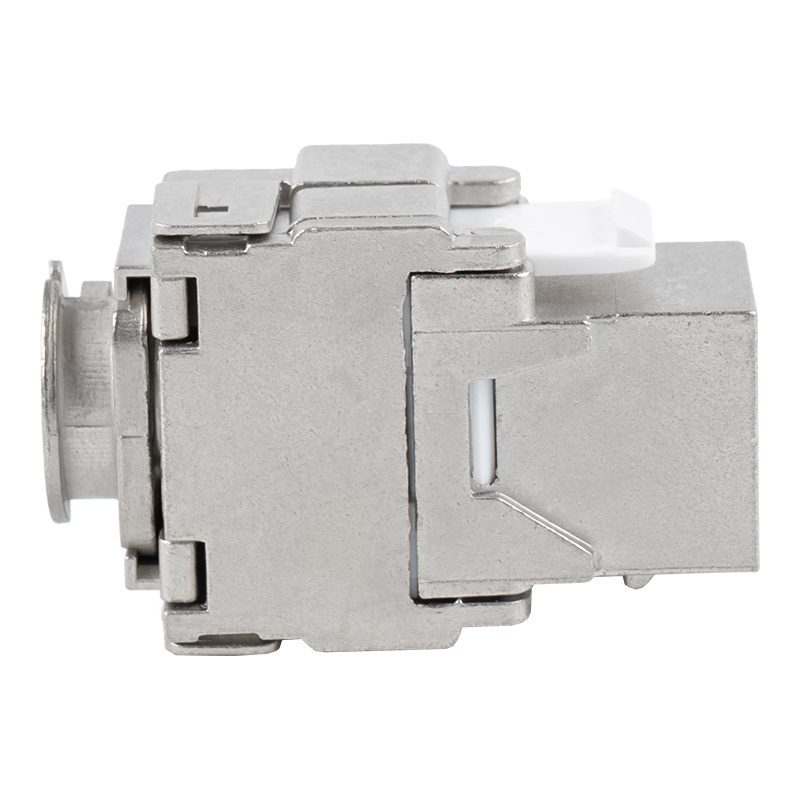 C6A Shielded 180° Tolless Keystone Jack (with bracket) SM-2335SH8C6A Supplier, FNingbo Betterbell Telecommunication is a China C6A Shielded 180° Tolless Keystone Jack (with bracket) SM-2335SH8C6A supplier and factory,...View Product →
High-Density Patching and Cable Management
AI racks push port density to the limit. A single compute rack can hold 48 to 96 copper ports for management and storage, plus multiple MPO trunks for accelerator traffic. Without deliberate cable management, the patching zone quickly becomes a wall of tangled cords.
Three reasons why cable management hardware is a core part of AI data center cabling infrastructure:
- Cooling. Tight cable bundles block cold-aisle airflow and create hotspots that reduce GPU performance.
- Troubleshooting. When a link fails, the exact path must be identifiable fast; neat bundles and clear labels save hours.
- Bend radius. Cable managers with brush strips or rings protect cables from sharp bends that cause return loss and alien crosstalk.
A 19-inch 1U shielded 24-port Cat6A patch panel is a practical building block for this environment. It terminates 24 copper links in a single rack unit and offers a labeled, serviceable patching front. Pair it with horizontal cable managers to keep the front of the rack clean and the airflow unobstructed.
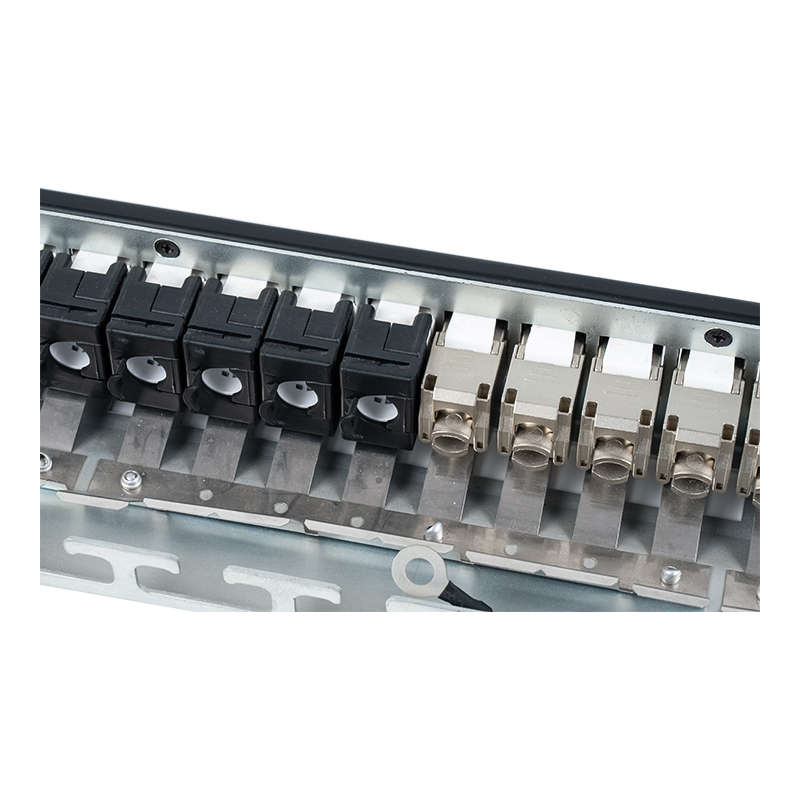 19-inch 1U 24-port shielded patch panel (with C6A module) SP-3246S-24P Supplier,Ningbo Betterbell Telecommunication is a China 19-inch 1U 24-port shielded patch panel (with C6A module) SP-3246S-24P supplier and factor...View Product →
Toolless Termination Saves Time at Scale
The scale of AI deployments turns field termination into a risk factor. Traditional RJ45 plugs require a crimp tool, careful pair arrangement, and consistent technique. If any step is rushed, the result is an intermittent link that fails only under load. With thousands of terminations per data hall, that failure mode is unacceptable.
Toolless plugs solve this by replacing the crimp operation with a simple, repeatable closing action. You trim the cable, arrange the pairs, and close the housing; internal contacts pierce the insulation and establish the connection. No impact tool, no exact crimp pressure, no guesswork. The result is more consistent terminations, especially when installation is spread across many technicians.
Shielded toolless connectors matter even more at 25G and 40G because the connector has to preserve precise pair geometry. A factory-designed toolless mechanism does this more reliably than a hand-crimped plug. For the short high-speed copper paths in an AI rack, a Cat8 shielded toolless RJ45 connector is a practical, field-friendly choice.
 Cat8 Shielded Toolless RJ45 Connector RJ-G40S-1-C8 Supplier, Factory - Ningbo BeNingbo Betterbell Telecommunication is a China Cat8 Shielded Toolless RJ45 Connector RJ-G40S-1-C8 supplier and factory, offering wholesal...View Product →
Testing, Polarity, and Documentation
AI networks fail in subtle ways. A parallel fiber link can light up even when polarity mistakes mean half the lanes are crossed. A copper link can pass a continuity check but fail insertion-loss limits at high frequency. That is why testing and documentation are part of the cabling infrastructure itself.
Fiber polarity deserves special attention. TIA-568 defines polarity methods A, B, and C; method B is the most common for parallel optics in AI rail networks. Each MPO connector must carry every transmit lane to the correct receive position at the far end. When polarity is wrong, a 400G link may report partial signals, and the troubleshooting effort becomes expensive.
On the copper side, every permanent link should be certified against the limits of its category using a qualified tester that checks insertion loss, return loss, and crosstalk. Document everything: labels on both ends of every cable, patch-panel port maps, and stored test results. Good documentation turns a painful incident into a fast fix.
Choosing a Manufacturing Partner for AI-Ready Cabling
The physical components of structured cabling look simple, but the tolerances are tight. A keystone jack or patch panel that meets the standard on paper can still perform inconsistently across a large deployment if the factory does not control every step. When you plan AI data center cabling infrastructure, evaluate manufacturing partners on three things:
- Certified performance: products tested against TIA and ISO requirements, with documentation you can audit.
- Batch consistency: in large AI projects, components behave the same whether shipped in the first order or the tenth.
- Customization ability: many integrators and operators need custom labeling, colors, packaging, or modified mechanical designs.
BTBL builds structured cabling components for data center, office, and industrial networks, with particular strength in toolless plugs, keystone jacks, patch panels, and cable managers. If your AI project requires adaptation of standard products, review the customization options and talk through the requirements with the engineering team before finalizing the bill of materials.
Frequently Asked Questions
Is fiber always the right choice for AI data center cabling?
No. Fiber is necessary for long-reach and parallel optics in rail networks, but copper handles short links below 30 meters efficiently. Many AI racks use Cat6A or Cat8 copper for server management and storage connections.
What is the difference between Cat6A and Cat8 for AI racks?
Cat6A supports 10G up to 100 meters and is a safe facility-wide default. Cat8 supports 25G or 40G up to 30 meters and fits the short, high-speed paths inside AI racks. Choose based on link distance and required data rate.
Why is toolless termination popular in AI data center builds?
Toolless connectors reduce dependence on crimp tools, produce more consistent terminations, and shorten deployment time. At thousands of ports per data hall, consistency and speed are major cost drivers.
What is the most common cabling issue in AI data centers?
It is rarely a single broken cable. The most common problems are polarity errors in parallel fiber links, high-frequency failures missed by basic testing, and poor cable management that blocks airflow and causes thermal throttling.
AI data center cabling infrastructure is not a commodity purchase; it is a design decision. Choose the right architecture, select copper and fiber components that match the actual link distances and speeds, terminate with methods that reduce human error, and document everything. When the physical layer is right, the network above it has a solid foundation for the next generation of AI workloads.
Contact Us
Your email address will not be published. Required field are marked*


-
 No. 588, Xiaolin Avenue, Xiaolin Town, Cixi City, Zhejiang Province
-
 [email protected]
-
 +86-574-63507962
-
 +86-15988643730
Copyright Ningbo Betterbell Telecommunication Equipment Co., Ltd. All rights reserved. Structured Cabling Solutions Manufacturer Network Cabling Products Supplier
