

 English
 Deutsch
 Español
 русский

Home · News · Industry News · How to Choose a Structured Cabling Manufacturer: The 7-Step Buyer Guide
Industry News
How to Choose a Structured Cabling Manufacturer: The 7-Step Buyer Guide
2026-08-21Content
- 1 1. Start from the performance category you actually need
- 2 2. Ask for manufacturing evidence, not a brochure
- 3 3. Choose a termination method your field team can execute consistently
- 4 4. Check certifications that survive an audit
- 5 5. Confirm customization and ODM/OEM flexibility before you need it
- 6 6. Compare total cost of ownership, not unit price
- 7 7. Verify lead times, shipping routes, and support speed
- 8 Frequently asked questions
- 9 Final checklist before you choose
Two integrators ordered the same Cat6A keystone jack specification last quarter. One bought at $0.38 per piece through an unverified trading platform; the other paid $0.61 to a manufacturer that runs its own molding, plating, and assembly lines. In a random sample of 120 terminations, the first batch produced 14 failures during channel certification testing. The second produced zero. That gap was not luck. It was the difference between buying components and buying a controlled manufacturing process.
The conclusion is simple: choose a structured cabling manufacturer that can prove process control in material selection, contact design, plating thickness, and batch traceability, and whose product range matches the network speed you actually intend to run. The steps below turn that conclusion into a repeatable supplier evaluation process.
1. Start from the performance category you actually need
Every structured cabling project begins with the channel class, because the class locks in frequency, data rate, cable distance, and connector design. Many buyers select cable first and then search for matching hardware. Experienced project managers do the reverse: they fix the channel class, then verify every component in the channel - keystone jacks, patch panels, plugs, and cable managers - against the same class.
| Category | Max frequency | Max data rate | Typical deployment |
|---|---|---|---|
| Cat5e | 100 MHz | 1 Gbps | Low-cost office links, legacy upgrades |
| Cat6 | 250 MHz | 10 Gbps up to 55 m | General office networks |
| Cat6A | 500 MHz | 10 Gbps to 100 m | Data centers, WLAN backbones, PoE deployments |
| Cat7 | 600 MHz | 10 Gbps | High-EMI industrial environments |
| Cat8 | 2000 MHz | 25/40 Gbps | Data center spine-leaf links |
Why this matters in supplier selection: a manufacturer that offers the full category range can support mixed designs within a single project, and it is more likely to maintain the tolerances required at higher frequencies. For 10GBASE-T and high-density environments, Cat6A shielded toolless keystone jacks with brackets reduce termination errors while keeping port density in the cabinet. Hardware details like this should be specified before you compare quotes, because they decide whether the projected channel margin will survive field installation.
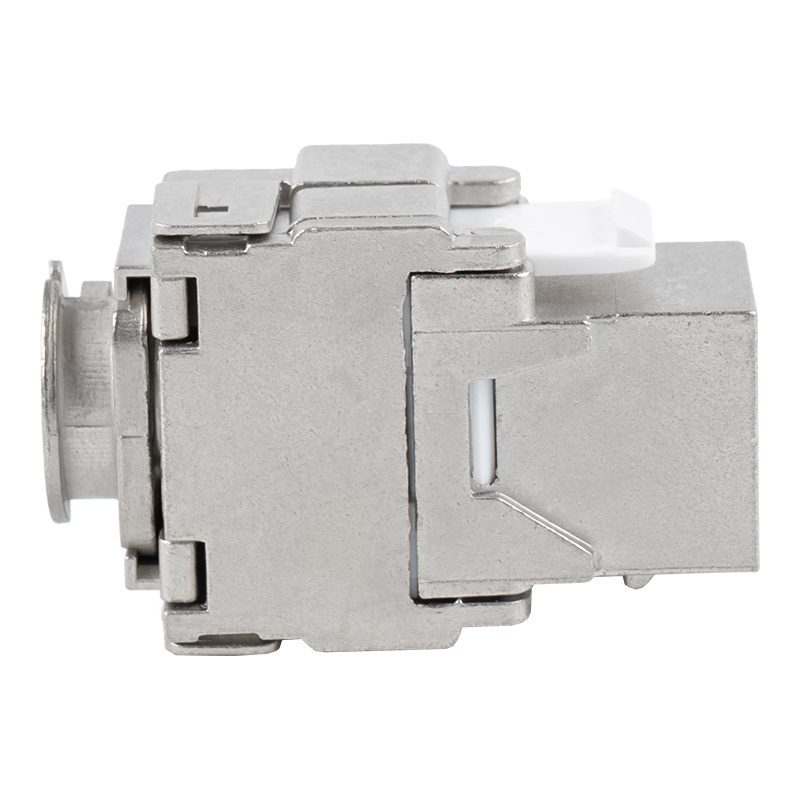 C6A Shielded 180° Tolless Keystone Jack (with bracket) SM-2335SH8C6A Supplier, FNingbo Betterbell Telecommunication is a China C6A Shielded 180° Tolless Keystone Jack (with bracket) SM-2335SH8C6A supplier and factory,...View Product →
2. Ask for manufacturing evidence, not a brochure
Trading companies and agent offices represent multiple factories and change sources based on price. That creates a hidden supply risk: the product you qualify today may be built on different tooling next month. A true manufacturer should be able to show control over the steps that determine transmission quality:
- In-house injection molding and metal stamping for contacts and housings
- Automated contact insertion with documented contact-resistance testing
- Controlled gold-plating thickness, typically 30 to 50 micro-inches on mating contacts
- Date codes, lot traceability, and retained samples per production batch
Ask for a factory tour. If you cannot travel, request a live video walkthrough of the assembly lines and testing benches. A legitimate manufacturer accommodates this quickly, because it knows that buyers have been burned by trading companies that overpromise and substitute components after the order is placed.
3. Choose a termination method your field team can execute consistently
Termination quality determines field reliability more than any other installation variable. Failure analysis in structured cabling projects repeatedly points to the connector: pairs untwisted too far, jackets stripped too long, or terminals damaged by excessive impact-tool force. The right manufacturer helps you avoid this by offering hardware that matches the skill level of your installation teams.
Toolless connectors remove most of these variables. A toolless RJ45 plug or keystone jack uses an internal insulation-displacement contact that pierces the conductors in a controlled stroke, instead of relying on installer strength and tool calibration. For companies managing large cabling crews, this translates directly into fewer rework visits and higher first-pass certification rates.
Typical average termination time per connection including cable preparation. Illustrative benchmarks for crew planning.
For 500 MHz channel integrity, Cat6A shielded toolless RJ45 connectors combine the speed of tool-free termination with the shielding performance required in environments with high electromagnetic interference. When a manufacturer offers toolless options across Cat6A and Cat7, it signals that the design team understands real-world installation conditions, not just laboratory test conditions.
 Shielded RJ45 Toolless Plug Supplier, RJ45 Connector FactoryNingbo Betterbell Telecommunication is a China shielded RJ45 toolless plug supplier and RJ45 connector factory, offering wholesale supply...View Product →
4. Check certifications that survive an audit
Certifications must be audit-proof, not decorative. A professional buyer verifies three levels of compliance: the factory's quality management system, the product's safety listing, and the independent transmission performance test report.
- Factory level: ISO 9001 certification covering production and testing processes
- Product safety: UL or ETL listing where required for plenum-rated or high-density components
- Performance level: TIA/EIA-568 and ISO/IEC 11801 test reports from independent laboratories
Ask for the test report number, the laboratory name, and the sample configuration for each product you plan to buy. A genuine manufacturer provides these within one business day. If the supplier only shows certificate photos on the website, treat that as a red flag rather than evidence of compliance.
5. Confirm customization and ODM/OEM flexibility before you need it
Very few projects use only standard catalog parts. Face plates with specific port legends, patch panels with colored label windows, and keystone jacks with particular wire-management features are common requirements in real deployments. The question is whether the manufacturer can execute engineering changes without destabilizing production. Before requesting a quote, review the manufacturer's documented customization options so you know which changes are free, which require new tooling, and how long a new sample will take.
The most reliable suppliers separate engineering and setup costs from per-unit pricing, and they state sample lead times in writing. That level of transparency tells you more about the ODM/OEM relationship than any sales presentation.
6. Compare total cost of ownership, not unit price
Unit price is the least honest number in cabling procurement. The reliable comparison is total cost of ownership: component price, freight, installation labor, testing and certification effort, rework probability, and the cost of downtime when rework happens in a live network.
- Cabling & connectors — 35%
- Patch panels & modules — 25%
- Installation labor — 25%
- Testing & certification — 10%
- Spares & maintenance — 5%
Illustrative cost distribution for a 48-port cabinet deployment. Actual figures vary by region and project type.
Rework in an occupied data center is dramatically more expensive than in new construction, because it involves planned outages, truck rolls, and recertification of the entire channel. This is why experienced procurement teams accept a 5% to 15% higher unit price from a manufacturer that ships consistent product. Components such as pre-loaded 24-port shielded Cat6 patch panels reduce cabinet assembly labor and shorten testing time, which directly attacks the largest labor cost in the chart above.
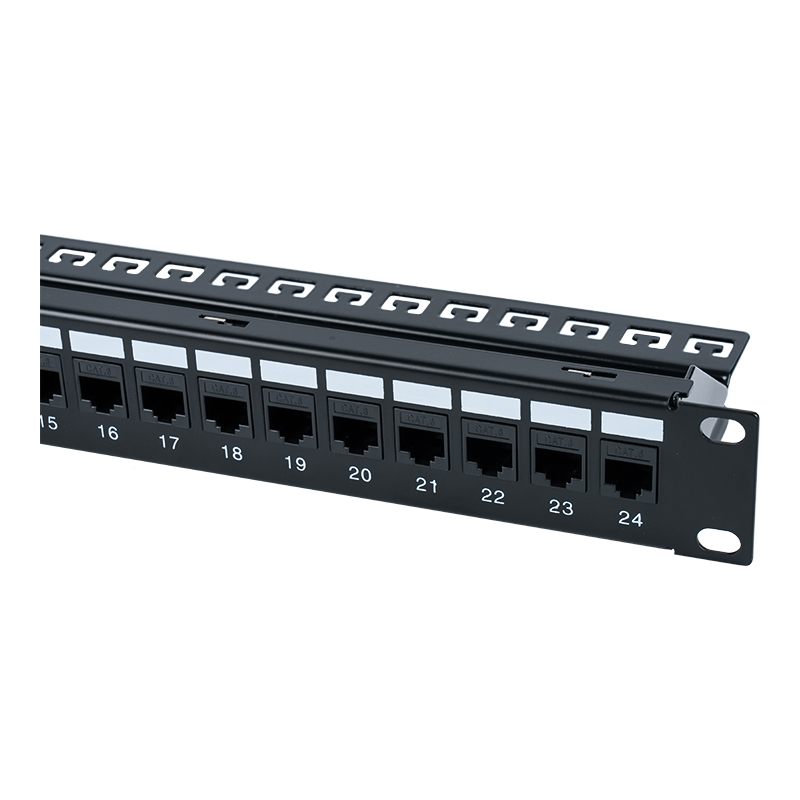 19-inch 1U 24-port shielded patch panel (with C6 module) SP-3260-24P Supplier, FNingbo Betterbell Telecommunication is a China 19-inch 1U 24-port shielded patch panel (with C6 module) SP-3260-24P supplier and factory,...View Product →
7. Verify lead times, shipping routes, and support speed
Location determines how quickly you recover from forecasting errors or a failed batch. Coastal manufacturing plants in eastern China, for example, sit within a short drive of Ningbo Port and Shanghai Port, which makes ocean freight schedules more predictable and keeps air-freight options within reach for urgent refills.
Ask for standard and custom lead times separately. A supplier that keeps common models such as 24-port patch panels and Cat6A modules in regular production cycles can offer shorter reorder intervals than one that treats every order as a custom batch. Also measure the support team while you still have time: send a short technical questionnaire and evaluate response quality. That small test predicts how your future urgent requests will be handled. For most international buyers, the fastest route is to contact the manufacturer directly with specifications, target quantities, and delivery port.
Frequently asked questions
How do I verify that a manufacturer is a real factory?
Request a live video walkthrough of production and testing areas, ask for export customs records, and confirm that the company owns the molds and tooling drawings for the products it sells. A genuine manufacturer can show batch traceability from raw material to finished goods.
Which category should a new office network use in 2026?
Cat6A is the realistic baseline, because it supports 10GBASE-T over the full 100 m channel and tolerates the electromagnetic noise common in dense office environments. Cat8 is reserved for data centers running 25G or 40G links.
Are toolless connectors as reliable as punch-down modules?
In controlled tests, toolless insulation-displacement connectors achieve comparable or better contact reliability because the termination stroke is determined by the connector mechanism, not by installer force. Verify that the manufacturer publishes mate-cycle and pull-out force test data before choosing.
What is the typical minimum order quantity for custom patch panels?
The answer depends on whether the customization is cosmetic, such as silkscreen and label windows, or structural, such as new mold tooling. Ask the manufacturer to separate engineering and setup costs from per-unit pricing so you can compare the real impact on your project budget.
Final checklist before you choose
- Lock the performance category; Cat6A is the practical baseline for most new installations.
- Verify in-house manufacturing and testing capabilities with a video factory tour.
- Choose a termination method that your installation team can execute consistently.
- Request third-party test reports and verify the report numbers.
- Confirm customization terms, including tooling costs and sample lead times.
- Calculate total cost of ownership, including rework and downtime.
- Validate logistics lead time and place a small trial order before committing to a full shipment.
None of these steps will make a project risk-free. But they will remove the most common causes of certification failures: mismatched component categories, uncontrolled terminations, and suppliers that do not actually manufacture what they quote. That is exactly where a structured cabling manufacturer earns its place in your supply chain.
Contact Us
Your email address will not be published. Required field are marked*


-
 No. 588, Xiaolin Avenue, Xiaolin Town, Cixi City, Zhejiang Province
-
 [email protected]
-
 +86-574-63507962
-
 +86-15988643730
Copyright Ningbo Betterbell Telecommunication Equipment Co., Ltd. All rights reserved. Structured Cabling Solutions Manufacturer Network Cabling Products Supplier
