

 English
 Deutsch
 Español
 русский

Home · News · Industry News · Angled vs Flat Patch Panel: Rack Space, Cable Bend Radius, and Real Cost
Industry News
Angled vs Flat Patch Panel: Rack Space, Cable Bend Radius, and Real Cost
2026-09-21Content
If your rack row has a front door, a containment gap, or more than eight 24-port panels in it, an angled patch panel will usually pay for itself. If the cabinet is shallow, wall mounted, or holds two panels and one switch, a flat panel with a good horizontal cable manager is cheaper, easier to label, and easier to swap out in a hurry.
That is the decision in two sentences. The rest of this page explains why: how the two geometries differ, what each one costs in rack units and front clearance, how they treat cable bend radius, and which format belongs in a data center row, an office comms room, or an industrial cabinet.
The Short Answer: Angled for Density, Flat for Flexibility
Both panels do the same electrical job. A 24-port flat panel and a 24-port angled panel use the same category of keystone jacks, the same rear termination blocks, and the same certification tests. The difference is mechanical: where the patch cords leave the face, and what that does to the space in front of the panel.
| Aspect | Flat patch panel | Angled patch panel |
|---|---|---|
| Port exit direction | Straight out, perpendicular to the mounting rail | 45-degree left and right, cords sweep into vertical managers |
| Rack units per 24-port row | 2U in most builds (1U panel plus 1U horizontal manager) | 1U, because management moves to the sides |
| Front clearance needed | Roughly 84 to 112 mm of cord sweep in front of the face | About 35 mm before the cords turn sideways |
| Bend control | Depends on manager depth, ring spacing, and bundle load | Built into the face angle of the panel |
| Cost and availability | Lower unit cost, more SKUs, faster lead times | Higher unit cost, fewer suppliers, longer lead times |
| Where it wins | Shallow cabinets, wall racks, low port counts, mixed rows | High-density row patching, containment, frequent moves |
Where the Rack Units Actually Go
A 24-port flat panel is 1U. The horizontal manager that almost always travels with it is another 1U, so a flat row quietly costs two rack units per panel. An angled panel does the same work in one unit, because the cords leave at an angle and run into the vertical manager on the rail instead of folding down in front of the panel.
Twelve 24-port panels serving 288 ports in one rack row: flat plus managers takes 24U, angled takes 12U. In a 42U rack that is 18U left for switches and servers against 30U. Most project teams make the decision on that single number, and it is a fair way to make it.
Whichever format you specify, the manager is not optional. A 19-inch 1U cable management panel with four plastic rings and a brush strip keeps the first bend under control and takes the weight of the bundle off the plugs.
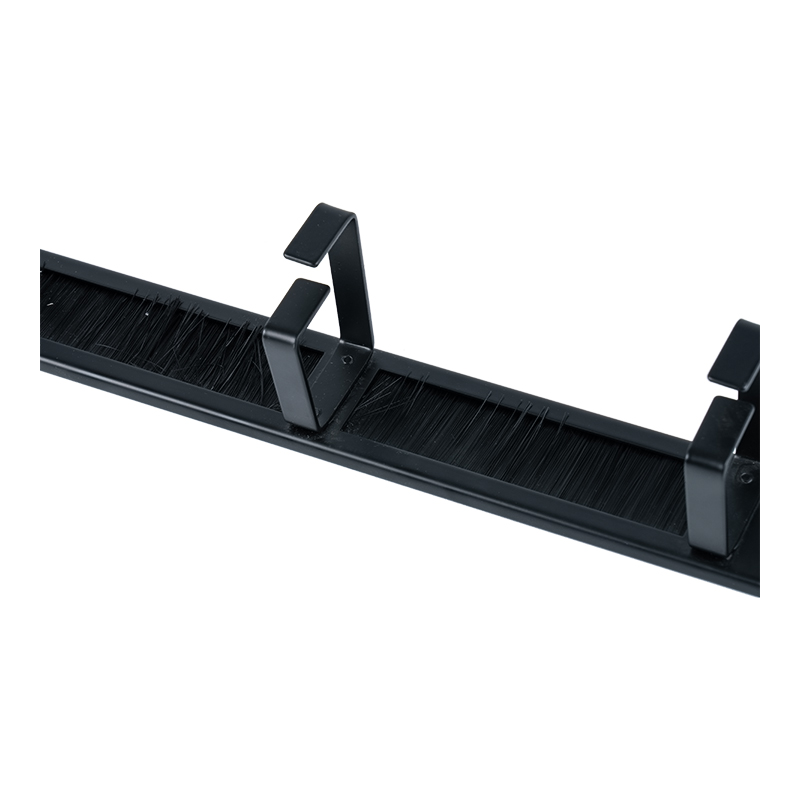 19-inch 4-Ring Plastic Cable Management Panel (with Brush) SP-3804-1UBrush-like Structure Design: Built-in brushes prevent dust accumulation and ensure neat cable routing, enhancing equipment protection.View Product →
Cable Bend Radius, Strain, and Airflow
Most Cat6 and Cat6A UTP cables are specified with a minimum installed bend radius of roughly four times the cable diameter. A 6.5 mm Cat6A cord therefore wants about 26 mm of radius at every bend, and the first bend behind the plug is the hardest one to control.
On a flat panel, the cord leaves the port straight, then folds down into the horizontal manager within the first 30 to 50 mm. If the manager is shallow, overloaded, or mounted a few millimetres too close to the panel, that bend tightens and the pair geometry at the plug changes. The result usually shows up as return loss and, in the worst case, as a failed certification test on ports that looked perfectly fine during termination.
An angled panel turns that first fold into a sweep. The cord leaves at an angle and continues in roughly the same direction into the vertical manager, so the radius is easier to hold at the plug and the bundle sits beside the rail instead of in front of it.
The secondary benefit is airflow. Cord bundles parked in front of the panel face sit directly in the cold aisle path and can block the intakes of switches mounted below the row. Angled panels keep the front face clear, which matters when the cabinet has a door, a containment panel, or a fixed blanking strategy in place.
Where Flat Panels Still Win
Flat panels are not the compromise option. On plenty of jobs they are simply the correct part, and specifying angled hardware there adds cost without adding value.
- Shallow cabinets. Below roughly 800 mm of usable depth, an angled face plus a sideways bundle can foul the rails or stop the front door from closing.
- Wall racks and small floor cabinets. There is no vertical manager to receive cords that exit sideways, so the geometry advantage disappears.
- Two or three panels per rack. The 1U saving per row rarely matters, and the lower unit cost does.
- Retrofit and urgent repair work. Flat panels are stocked almost everywhere, which keeps downtime short.
- Legibility and speed. Ports facing the technician straight on are faster to read and patch when labels are small and lighting is poor.
A 19-inch 1U 24-port unshielded rack panel covers the flat use cases described above and accepts standard keystone modules, which keeps field spares simple.
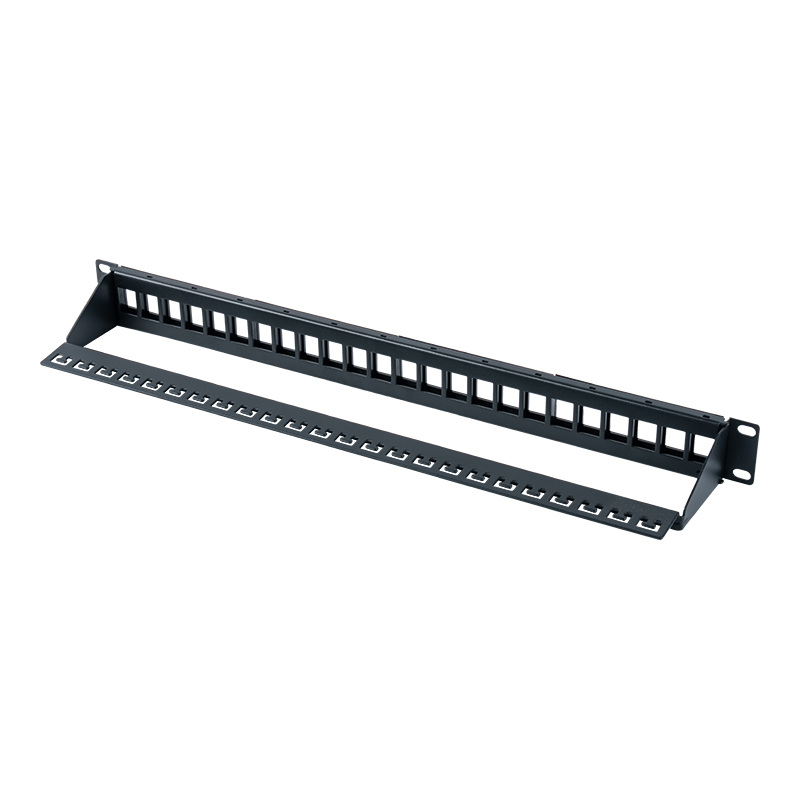 19-inch 1U 24-port unshielded rack SP-3403-24PStandard 24-Port Module Bays Compatible with various unshielded Keystone modules such as Cat5e, Cat6, and Cat6A, allowing for flexible configuration.View Product →
Matching the Panel to the Room
Data center cross-connect and MDA rows
Go angled. High port counts, frequent patching, and containment all push in the same direction, and the rack unit saving generally covers the price difference within a single row.
Enterprise comms rooms
Mixed. If panels are stacked with switches in a 42U cabinet and there is room for horizontal managers, flat panels with managers are entirely adequate and cost less.
Industrial and outdoor enclosures
Check depth before anything else. Angled panels help where vibration and repeated movement make bend control important, but a shallow enclosure may not accept the sideways bundle.
Small branch racks
Flat. Two panels, one switch, no vertical manager, no geometry argument.
- Data center rows 40%
- Enterprise comms rooms 25%
- Industrial cabinets 20%
- Small office racks 15%
Termination and Installation Details That Decide the Outcome
In practice, projects are decided less by panel geometry than by how the row is terminated, bonded, and labelled.
- Termination style. 90-degree keystone jacks suit tight cabinets where the installer works from the front. 180-degree modules suit rear-access frames and keep the cable bundle flat against the rail. A toolless termination design removes the punch-down tool from the job and reduces the chance of a mis-seated conductor on a fully loaded 24-port panel.
- Shielding and bonding. Shielded Cat6A layouts need the drain wire bonded to the panel and the panel bonded to the rack earth. An ungrounded shielded row performs worse than an unshielded one.
- Labelling. Replaceable label windows or numbered cards survive several rounds of adds, moves, and changes better than printed paper taped to the frame.
- Test after dressing. Certify the row once the cords are routed, not before. Bend radius problems appear only after dressing.
A Cat6A unshielded 180-degree toolless keystone jack is a common choice for these rows, since it can be terminated on the bench and clipped in afterwards.
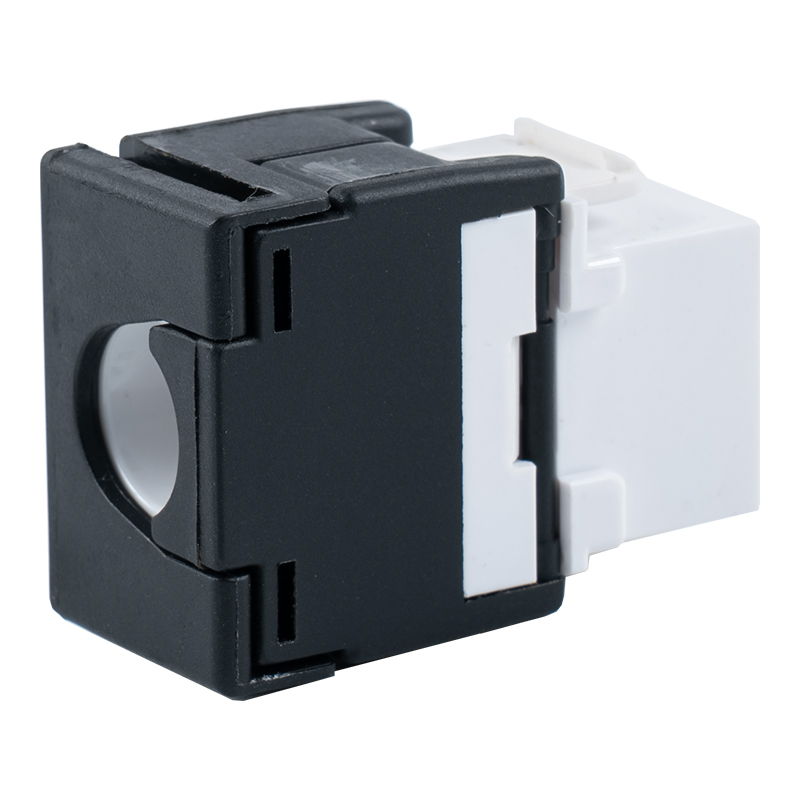 C6A Unshielded 180° Tolless Keystone Jack SM-2335H8C6AToolless Termination Quick tool-free termination 10-Gigabit Performance Complies with Cat6A/Class EA standards for 10Gbps Ethernet and 500MHz frequency bandwidth. 180°...View Product →
For rows with non-standard port counts, pre-labelled panels, or shielded variants, this is a normal engineering conversation rather than a special project, and the customization options page explains how those builds are handled. If you want to understand why toolless parts hold up in the field, this background on toolless termination design is a useful read.
Frequently Asked Questions
Does an angled panel fix bend radius problems by itself?
No. It changes the direction of the first bend and makes a good radius easier to maintain, but the bundle still needs strain relief and adequate manager spacing. Dressing discipline matters more than the panel angle.
Can I use 0.5 m patch cords with an angled panel?
Usually yes, but side routing adds a few centimetres to the path. Test one row with your chosen cord length before ordering several hundred of them.
Will an angled panel fit a 600 mm deep cabinet?
Often, but not always. Some 45-degree designs add meaningful forward projection. Check the panel depth against the door swing and any containment panel before you commit to a full row.
Is the 1U saving real?
It is real if you would otherwise fit a horizontal manager under every panel. In a shallow rack where you would not fit one anyway, there is no saving to collect.
Decide in five steps: measure usable cabinet depth and front clearance with the door closed; count ports and panels per row; confirm whether horizontal or vertical cable management fits the rack; check cord length and labelling needs; then buy the manager together with the panel. Angled panels earn their price in dense, frequently patched rows. Flat panels earn theirs everywhere space and budget are tight, and neither choice is wrong when it matches the rack in front of you.
Contact Us
Your email address will not be published. Required field are marked*


-
 No. 588, Xiaolin Avenue, Xiaolin Town, Cixi City, Zhejiang Province
-
 [email protected]
-
 +86-574-63507962
-
 +86-15988643730
Copyright Ningbo Betterbell Telecommunication Equipment Co., Ltd. All rights reserved. Structured Cabling Solutions Manufacturer Network Cabling Products Supplier
