

 English
 Deutsch
 Español
 русский

Home · News · Industry News · 24 Port Patch Panel vs 48 Port: Rack Density, Cost per Port and Layout
Industry News
24 Port Patch Panel vs 48 Port: Rack Density, Cost per Port and Layout
2026-09-25Content
- 1 The short answer: 24 ports for hands, 48 ports for space
- 2 What actually fits into 1U: rows, IDC blocks and rear channel
- 3 24 port vs 48 port: the comparison table
- 4 Rear congestion is the hidden cost of 48 ports
- 5 Cost per port and fill rate: the two numbers that decide
- 6 Rack layout patterns that stay manageable
- 7 Which one should you specify?
- 8 Panels and modules from a single supplier
- 9 FAQ
Ninety-six Cat6A cables, one 42U cabinet, two ways to terminate them: four 24-port panels stacked in 4U, or two 48-port panels squeezed into 2U. The port count is identical. Everything else changes, from rear bend radius and label legibility to patch cord dressing and how long a move-add-change takes at 2 a.m.
This comparison is written for the people who terminate the panel, dress the bundle behind it, and reopen the same cabinet two years later.
The short answer: 24 ports for hands, 48 ports for space
If technicians patch, re-patch and audit the rack, two 24-port panels beat one 48-port panel in most offices and IDFs. If the cabinet sits in a data hall where links are documented once and rarely touched, a 48-port 1U panel wins on rack units and cost per port.
The deciding factor is rarely port count. It is rear clearance. A 48-port 1U panel packs four 12-way termination blocks into the same 44.45 mm of height that holds two blocks on a 24-port panel, and the cable bundle behind it grows with them. With shielded Cat6A, the panel starts to fight the cable.
A 48-port panel is not twice the price of a 24-port panel, usually 1.4 to 1.7 times. Cost per port therefore favors 48 ports, until you add the horizontal managers and the extra rear channel needed to make a 48-port panel behave.
What actually fits into 1U: rows, IDC blocks and rear channel
A 19-inch 1U panel occupies 44.45 mm of vertical space. On a 24-port unit that space holds two horizontal rows of 12 ports and two 12-way IDC blocks. On a 48-port unit the same 44.45 mm holds four rows of 12 (some designs use two rows of 24) and four IDC blocks.
That doubling is where the real difference lives. Standard Cat6 UTP cable runs roughly 5.9 to 6.5 mm in outer diameter, so a 24-cable bundle measures about 35 to 45 mm across, while 48 cables reach 55 to 70 mm. Shielded Cat6A at 7.5 to 8.5 mm outer diameter adds another 30 to 40 percent to every one of those numbers.
Bend radius guidance compounds the problem. Common field practice allows a radius of about four times the cable outer diameter for unshielded constructions and up to eight times for shielded ones. An 8 mm Cat6A cable therefore wants roughly 64 mm of clear radius, and 48 of them want a rear channel of 130 to 160 mm before the bundle is dressed and tied.
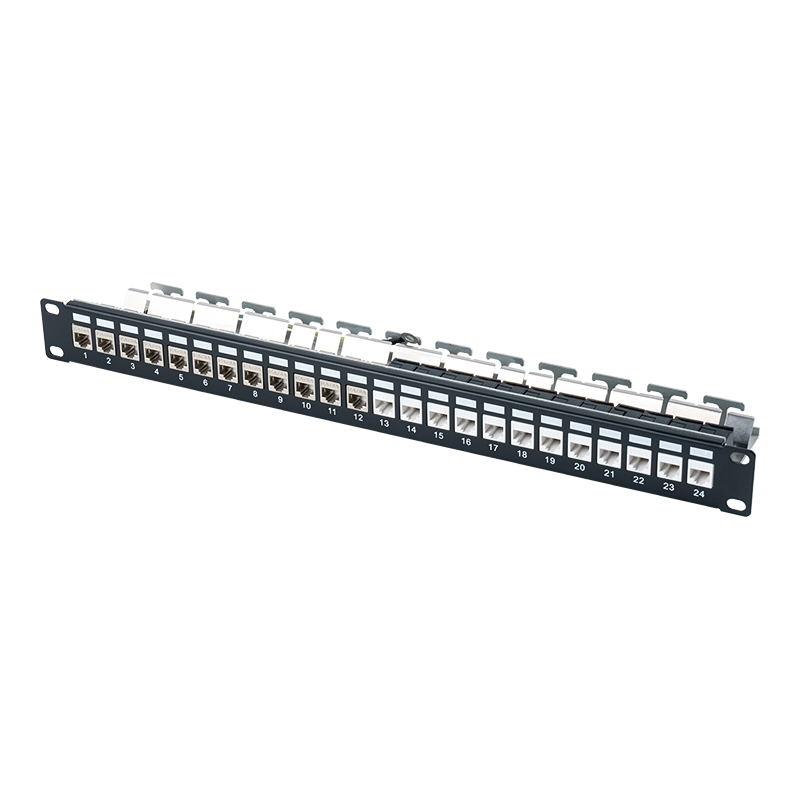 19-inch 1U 24-port shielded empty rack (with digital card) SP-3245S-24PThe 19-inch 1U 24-port shielded empty rack (with digital card) is a high-density RJ45 patch panel designed for server rooms, data centers, and enterprise network cabli...View Product →
Modular empty racks are one way to keep this manageable: you buy the frame once, then load it with Cat5e, Cat6 or Cat6A modules as the floor plan firms up, and swap modules instead of entire panels when a port is damaged.
24 port vs 48 port: the comparison table
The table below compares one 1U panel of each format under identical Cat6A shielded conditions.
| Factor | 24-port 1U panel | 48-port 1U panel |
|---|---|---|
| Ports and rows | 24 ports, 2 rows of 12, 2 IDC blocks | 48 ports, 4 rows of 12, 4 IDC blocks |
| Rack units per 48 ports | 2U | 1U |
| Front patch cords | Up to 24 | Up to 48 |
| Rear channel, Cat6A shielded | About 80 to 100 mm | About 130 to 160 mm |
| Label windows | Larger, readable at a glance | Smaller, dense numbering |
| Relative cost per port | Index 100 | Index 72 to 80 |
| Move-add-change time | Shorter per port | Longer, needs a documented plan |
| Typical fit | Offices, IDFs, hands-on racks | Data halls, pre-planned patching |
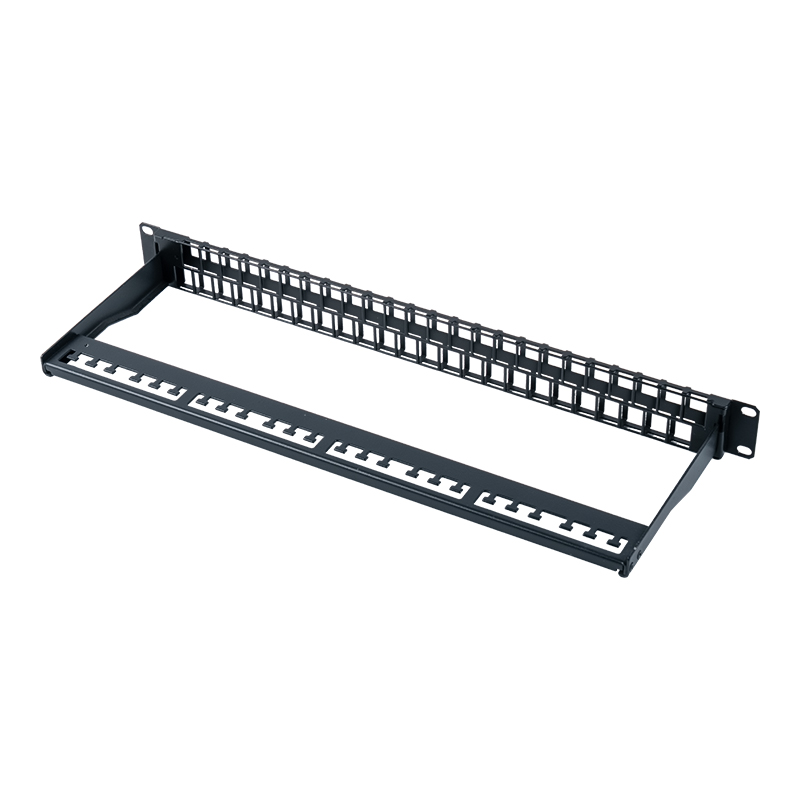 19‑inch 1U 48‑port Shielded Empty Rack SP-3315S-48PThe 19‑inch 1U 48‑port Shielded Empty Rack is a high-density cabling solution designed for server rooms, data centers, and large enterprise network environments. It us...View Product →
Stand behind a fully dressed 48-port 1U panel and the trade-off is obvious. Termination blocks sit closer together, the bundle turns tighter, and the last twelve cables are usually the ones that get pushed rather than placed. That is where return loss and alien crosstalk problems are born, long before anyone runs a certification tester.
The mitigations are mechanical, not electrical:
- Add a 1U horizontal manager with rings or a brush strip directly above or below the panel.
- Use vertical managers on both rack sides so bundles never cross the rear channel diagonally.
- Choose a 2U 48-port panel when rear room matters more than one rack unit.
- Split permanent and growth cabling between a 48-port panel and a 24-port panel in the same rack.
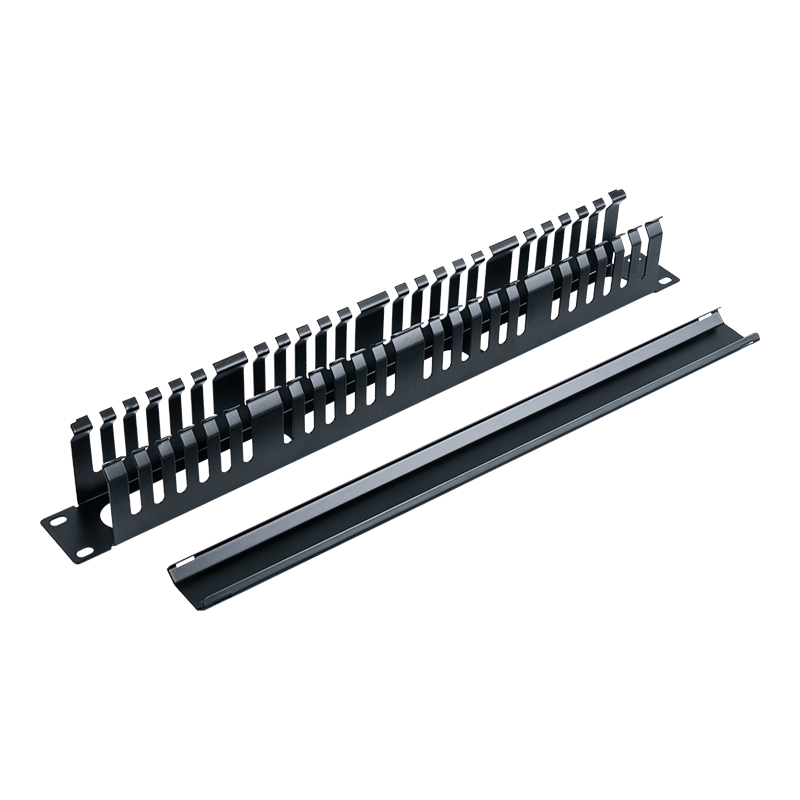 19-inch 1U Plastic Cable Management Panel (24 Slots with Cover) SP-3802-1UOptimized Cable Management: 19-inch 1U Plastic Cable Management Panel (24 Slots with Cover) features a unique design for easy and clear organization and management of ...View Product →
Cost per port and fill rate: the two numbers that decide
When purchasing pushes back on price, the useful metric is cost per terminated port, not cost per panel. A 48-port unit wins on that metric on the invoice and can lose it after installation: add one horizontal manager per panel plus the extra rear space, and the gap closes to roughly parity in a 42U cabinet.
Fill rate matters just as much. A 24-port panel is often 60 to 80 percent filled at go-live, while a 48-port panel typically starts at 40 to 60 percent. If your design fill rate is under 50 percent, you have bought spare capacity in a format that is harder to work in.
Rack layout patterns that stay manageable
Three layouts cover most projects. Pick one before you order, because the pattern determines whether you buy 2U of panels or 1U.
- Sandwich pattern: a 24-port panel, a 24-port switch, a 1U cable manager, then repeat. Ideal for IDFs and any rack that sees frequent patching.
- Dense pattern: one 48-port panel plus one 48-port switch, with a 1U horizontal manager per panel and vertical managers on both sides. Best when rack units are scarce and patching is planned.
- Mixed pattern: a 48-port panel for permanent runs at the top of the rack and a 24-port panel for growth below. It keeps day-2 work in the easier format without giving up density where it counts.
Leaving a single blank 1U between two 48-port panels adds about 40 mm of rear channel and costs little, which is often enough to bring shielded bundles back inside their bend radius.
Which one should you specify?
Choose 24-port when
- Technicians patch and audit the rack regularly.
- Ports per cabinet stay under roughly 200, or you grow in small increments.
- The rack is small, wall-mounted or has limited rear depth.
Choose 48-port when
- Rack units are the binding constraint, such as colocation cabinets billed per U.
- Links are documented, labeled and rarely moved.
- You can give the panel 130 to 160 mm of clear rear channel and a horizontal manager.
Choose two 24-port panels in one rack when
- You want 48 ports but the bundle is shielded Cat6A or Cat6.
- Two separate switches or two separate tenant zones share the cabinet.
- You may relocate or reuse half the capacity later.
Panels and modules from a single supplier
Ningbo Betterbell (BTBL) has manufactured structured cabling hardware since 2002, including 19-inch and 10-inch patch panels in 8, 12, 16, 24 and 48 port configurations, shielded and unshielded, as empty racks or preloaded with Cat5e, Cat6 and Cat6A modules, plus Cat3 voice panels and matching cable managers.
Because panels, keystone jacks and toolless plugs come from the same production line, port density, module fit and labeling stay consistent across a project. ODM and OEM programs are available for distributors who need a specific port count, label format or panel height, and you can review the customization options before locking a specification.
FAQ
Is a 48-port panel always the denser choice?
Only at the front of the rack. It doubles front port density in 44.45 mm, but it also doubles the rear bundle and the patch cord count. Once a horizontal manager is added, the practical space saving is roughly half a rack unit per 48 ports.
Can I run a 48-port panel with a 24-port switch?
Yes. You simply leave half the panel unpatched, which is a reasonable growth strategy as long as the labeling reflects the pairing from day one.
Does panel port count have to match switch port count?
No, but a 1:1 mapping between panel ports and switch ports shortens fault tracing noticeably. Where counts differ, document the cross-connect table on the cabinet door.
Does a 48-port panel need more cable management?
Yes. Budget at least one 1U horizontal manager per 48-port panel plus vertical managers on both sides. Without them, the rear bundle will sit outside its recommended bend radius.
Are angled patch panels a better option for 48 ports?
Angled panels improve front cord routing and reduce strain on high-count panels. Check rear clearance and cabinet door depth first, since the angle moves the bundle rather than removing it.
Twenty-four ports buy you working room; forty-eight ports buy you rack units. Decide which one your team will actually pay for in year three, then order the panel, the manager and the modules together so the geometry works before the first cable is terminated. If you want a second opinion on a bill of materials, our team can help with technical support and quotations.
Contact Us
Your email address will not be published. Required field are marked*


-
 No. 588, Xiaolin Avenue, Xiaolin Town, Cixi City, Zhejiang Province
-
 [email protected]
-
 +86-574-63507962
-
 +86-15988643730
Copyright Ningbo Betterbell Telecommunication Equipment Co., Ltd. All rights reserved. Structured Cabling Solutions Manufacturer Network Cabling Products Supplier
