

 English
 Deutsch
 Español
 русский

Home · News · Industry News · Which Keystone Jack Specification Fits Your Network Infrastructure Upgrade?
Industry News
Which Keystone Jack Specification Fits Your Network Infrastructure Upgrade?
2026-05-22Content
- 1 Core Technical Specifications and Performance Boundaries of Keystone Jacks
- 2 How Toolless Installation Technology Is Reshaping Keystone Jack Deployment Efficiency
- 3 Keystone Jack vs. RJ45 Plug: Functional Positioning and Synergistic Relationship
- 4 In-Depth Application Analysis: From Data Centers to Smart Buildings
- 5 Selection Guide: How to Match the Optimal Keystone Jack Solution for Your Project
- 6 Structured Cabling Product Ecosystem: From Modules to System-Level Solutions
- 7 Industry Trends: Higher Speeds, Intelligence, and Green Energy Efficiency
The global structured cabling market is experiencing significant growth, and Keystone Jack, as the core component of modular connection systems, has become an irreplaceable standard interface in data centers, enterprise offices, and smart home deployments. According to industry research estimates, the global network infrastructure market exceeded $45 billion in 2024, with modular connection components (including Keystone Jacks and their accompanying faceplates and patch panels) accounting for approximately 18% to 22%. The core driver of this growth lies in the evolution of network bandwidth demands from Gigabit to 10 Gigabit and beyond, while the modular nature of Keystone Jacks precisely meets the dual requirements of flexible upgrades and rapid maintenance.
From a deployment perspective, cabling solutions utilizing Keystone Jack systems can reduce port expansion time by over 60%. When network architectures require additional fiber ports, HDMI video interfaces, or higher-specification Ethernet modules, technicians need not re-cable—simply inserting the corresponding module into the existing faceplate completes the upgrade. This "plug-and-play" capability has earned exceptionally high adoption rates in high-density data center cabinets and enterprise telecommunications room renovations.
Core Technical Specifications and Performance Boundaries of Keystone Jacks
Keystone Jack is not a single product but a modular interface series encompassing multiple communication standards. Its technical performance directly determines the transmission stability and lifecycle of the entire cabling system. Below is a comparison of core specifications for mainstream Keystone Jacks currently on the market:
| Specification Category | Cat5e | Cat6 | Cat6A | Cat8 |
|---|---|---|---|---|
| Max Transmission Rate | 1 Gbps | 10 Gbps | 10 Gbps | 25 / 40 Gbps |
| Max Bandwidth | 100 MHz | 250 MHz | 500 MHz | 2000 MHz |
| Typical Distance (High Speed) | 100 meters | 55 meters (10Gbps) | 100 meters | 30 meters |
| Shielding Type | UTP / FTP | UTP / STP | STP / SSTP | S/FTP (Fully Shielded) |
| Primary Application | Basic Office Networks | Enterprise Gigabit/10G Access | Data Centers, Industrial Environments | Server Direct Connect, HFT |
As clearly shown in the table, Cat6A is the current mainstream choice for enterprise-grade cabling, stably supporting 10Gbps transmission over 100 meters while balancing cost and performance. Although Cat8 offers bandwidth up to 2000 MHz, its 30-meter transmission distance limits application scenarios, primarily serving short-distance high-speed interconnections within server cabinets.
How Toolless Installation Technology Is Reshaping Keystone Jack Deployment Efficiency
Traditional Keystone Jack installation relies on professional tools such as punch-down tools, with single-port construction time averaging 3 to 5 minutes and requiring considerable operator proficiency. The advent of toolless designs has fundamentally changed this landscape. Toolless Keystone Jacks employ spring-press or snap-lock mechanisms, allowing technicians to simply place conductors into corresponding slots according to color codes and press the cover plate to complete termination.
Core Advantages of Toolless Installation
- Single-port installation time reduced from 3-5 minutes to under 30 seconds, representing an efficiency gain exceeding 80%
- Reduced contact failure rates caused by uneven punch-down force, with port pass rates improving to above 99.5%
- Decreased dependency on specialized tools, lowering on-site labor costs and tool wear
- Supports rapid on-site replacement and maintenance, with modules maintaining stable performance through over 750 insertion/removal cycles
Efficiency Comparison in Real-World Deployment
Taking a typical medium-sized data center requiring 500 network ports as an example: using traditional punch-down Keystone Jacks, two skilled technicians would need approximately 25 to 30 hours to complete all terminations. With toolless modules, the same workload can be completed within 4 to 5 hours, and subsequent port changes or upgrades require no re-termination—simply replacing the module suffices. For机房 environments requiring frequent network topology adjustments, this advantage is particularly pronounced.
Keystone Jack vs. RJ45 Plug: Functional Positioning and Synergistic Relationship
In the structured cabling field, Keystone Jacks and RJ45 plugs are frequently mentioned together, yet their functional positioning differs fundamentally. Understanding this distinction is crucial for properly designing cabling solutions.
| Comparison Dimension | Keystone Jack | RJ45 Plug |
|---|---|---|
| Functional Positioning | Fixed port module installed in faceplates or patch panels | Movable connector crimped onto cable ends |
| Installation Location | Wall information outlets, cabinet patch panels, telecom enclosures | Both ends of patch cords, connecting devices to ports |
| Maintenance Method | Modular plug-and-play, supports hot-swapping | Requires re-crimping, typically single-use |
| Service Life | Insertion life exceeding 750 cycles | Insertion life approximately 1,000 cycles (patch cord level) |
| Flexibility | Can be replaced with fiber, HDMI, USB, and other modules | Supports only RJ45 interface type |
In essence, the Keystone Jack serves as the "fixed anchor point" of the cabling system, while the RJ45 plug acts as the "movable bridge." They physically mate through insertion to complete signal transmission, yet play distinctly different roles in system architecture. A well-designed cabling solution should fully leverage the modular advantages of Keystone Jacks to maximize port change flexibility while utilizing high-quality patch cords to ensure reliable end-point connections.
In-Depth Application Analysis: From Data Centers to Smart Buildings
High-Density Cabling in Data Centers
In data center environments, per-cabinet port density has evolved from early 24 to 48 ports to current levels of 96 to 144 ports or higher. Keystone Jacks paired with high-density patch panels can achieve deployment of 48 Cat6A ports within 1U of space. More importantly, as networks evolve from 10G to 25G/40G, technicians need not dismantle existing patch panels—simply replacing Cat6A modules with higher-specification shielded modules suffices, avoiding large-scale downtime for renovation.
Intelligent Upgrades for Enterprise Office Networks
Modern smart office spaces impose diversified requirements on cabling systems. Beyond traditional network access points, conference rooms require HDMI video transmission, USB charging, and audio input interfaces. The modular nature of Keystone Jacks allows mixed deployment within a single faceplate:
- RJ45 Network Module: Supports PoE power delivery for IP phones and wireless APs
- HDMI Keystone Module: Enables lossless transmission of 4K/8K video signals
- Fiber Keystone Module: Provides 10G+ bandwidth for long-distance backbone links
- USB Charging Module: Meets convenient power demands for mobile devices
Industrial Communications and Harsh Environments
Cabling systems in industrial scenarios face multiple challenges including vibration, dust, and electromagnetic interference. Keystone Jacks with all-metal shielded housings paired with SSTP shielded cables can suppress external electromagnetic interference (EMI) to below -40 dB, ensuring stable operation of industrial Ethernet protocols (Profinet, EtherCAT, etc.). Additionally, certain industrial-grade modules support a wide operating temperature range of -40°C to +85°C, adapting to outdoor enclosures or production floor environments.
Selection Guide: How to Match the Optimal Keystone Jack Solution for Your Project
Faced with the wide variety of Keystone Jack products on the market, project decision-makers need to conduct systematic evaluations across the following dimensions:
Bandwidth Requirements and Specification Matching
First, clarify current and 5-to-10-year bandwidth planning. If the project is primarily Gigabit-based with no short-term upgrade plans, Cat5e or Cat6 will suffice. However, if 4K video transmission, Wi-Fi 6/7 backhaul, or data center applications are involved, Cat6A is the minimum threshold, while Cat8 is suitable for server direct-connect scenarios within cabinets. Note that system performance follows the "bucket effect"—even with Cat8 modules, if patch panels, cables, or patch cords are mismatched, overall transmission rates will still be limited by the weakest component.
Shielding Level and Environmental Adaptation
Shielding type selection should be based on electromagnetic environment assessment:
- UTP (Unshielded): Suitable for general office environments, lowest cost, simplest installation
- FTP (Foil Twisted Pair): Suitable for environments with light electromagnetic interference, such as areas near elevator machine rooms or electrical distribution rooms
- STP/SSTP (Shielded/Screened): Suitable for high-EMI environments such as factory floors and data centers, requiring full shield grounding throughout
Installation Efficiency and Maintenance Costs
For medium-to-large projects exceeding 200 ports, the comprehensive cost advantages of toolless Keystone Jacks become significantly apparent. Although per-module procurement costs are slightly higher than traditional punch-down products, the saved labor hours, reduced rework rates, and maintenance convenience typically recover the incremental investment within 12 to 18 months after project delivery. For smart building projects requiring frequent port function adjustments, the long-term value of modular design is even more pronounced.
Structured Cabling Product Ecosystem: From Modules to System-Level Solutions
A complete structured cabling system extends far beyond Keystone Jacks themselves, comprising multiple interdependent components that form an integrated whole. From modular interface units to system-level management and protection facilities, each element directly impacts the network's long-term stability and scalability. Below are the core product categories that constitute modern cabling systems and their functional positioning:
Core Connection Components
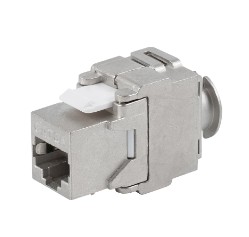
Keystone Jack serves as the core of modular interfaces, typically manufactured by specialized Keystone Jack factory operations to ensure each port meets industry standards for electrical performance and mechanical durability. The complementary Modular jack provides greater interface adaptability, with Modular jack factory production following strict quality control protocols. At the patch cord end, RJ45 Connector reliably terminates network cables to device ports, with high-quality RJ45 Connector factory products ensuring signals maintain low attenuation and high return loss even under frequent insertion and removal cycles.
Patching and Faceplate Systems
At the physical infrastructure layer, Patch panel is an indispensable centralized management device in data centers and telecommunications rooms. Professional Patch panel factory operations offer specifications ranging from 12-port to 96-port configurations based on port density, shielding requirements, and installation environments. Face plate represents the terminal presentation of wall cabling, with Face plate factory offerings typically including single, dual, quad, and sextuple port configurations that support flexible Keystone module combinations. For outdoor or industrial scenarios requiring additional protection, Mounting box and Bottom box provide physical dust, water, and impact resistance, with Mounting box factory and Bottom box factory solutions available in metal or engineered plastic housings according to IP protection ratings and material requirements.
Toolless and Shielded Connection Solutions
As construction efficiency demands increase, Toolless Connector and Toolless plug have become market mainstream. Toolless Connector factory and Toolless plug factory operations optimize spring structures and contact designs to reduce on-site termination time to one-fifth of traditional methods. In industrial and data center environments with complex electromagnetic conditions, Shielded RJ45 Toolless Plug delivers dual advantages of toolless convenience and full-shielding reliability, with Shielded RJ45 Toolless Plug factory operations typically conducting precision engineering validation on metal shield housings and crimp structures to ensure shielding effectiveness exceeds -40 dB.
Cable Management and Special Environment Adaptation
In high-density cabling environments, cable organization directly impacts thermal management and maintenance efficiency. Cable Management products include horizontal cable rings, vertical cable managers, and tie-wrap mounting bases, with Cable Management factory offerings available in multiple specifications based on cabinet depth and cable diameter. For extension or adapter scenarios, Inline Coupler enables reliable splicing of two cable segments without altering the cabling structure, with Inline Coupler factory products typically available in shielded and unshielded versions to match different environments. For outdoor, underground, or underwater extreme conditions, IP68 connector provides the highest level of dust and water protection, with IP68 connector factory products requiring rigorous immersion and dust testing to ensure continuous operation at 1.5 meters water depth for over 30 minutes.
Special Angle and Space Optimization Solutions
In space-constrained cabinet rear panels or corner positions, 90 Degree Keystone Jack redirects the cable exit perpendicular to the faceplate plane, effectively reducing patch cord bend radius and spatial footprint. 90 Degree Keystone Jack factory design teams must pay particular attention to internal PCB trace signal integrity, ensuring that the 90-degree转角 structure maintains Cat6A and higher specification transmission performance. This design is especially popular in 1U high-density patch panels and wall-mounted compact cabinets.
Industry Trends: Higher Speeds, Intelligence, and Green Energy Efficiency
Looking ahead, the Keystone Jack and structured cabling industry is evolving in three clear directions:
Continuous Speed Escalation: As 400G Ethernet standards gradually take hold, bandwidth requirements for connection components will further increase. Next-generation Keystone Jacks will need to achieve higher signal integrity within smaller physical footprints, posing greater demands on materials science (such as low-loss PCB substrates) and contact design.
Integrated Intelligent Management: Some high-end patch panels have begun integrating port status monitoring capabilities, displaying real-time connection status, transmission rates, and fault alerts for each Keystone Jack port through LED indicators or network management interfaces. This "visualized cabling" capability will significantly shorten troubleshooting time.
Green Energy Orientation: The proliferation of PoE (Power over Ethernet) technology means Keystone Jacks must not only transmit data but also carry electrical power. The new PoE++ (802.3bt) standard supports single-port output of 90W, presenting new challenges for module thermal design and current-carrying capacity. Simultaneously, the industry is exploring more environmentally friendly material solutions, such as halogen-free flame-retardant housings and recyclable metal plating.
Contact Us
Your email address will not be published. Required field are marked*


-
 No. 588, Xiaolin Avenue, Xiaolin Town, Cixi City, Zhejiang Province
-
 [email protected]
-
 +86-574-63507962
-
 +86-15988643730
Copyright Ningbo Betterbell Telecommunication Equipment Co., Ltd. All rights reserved. Structured Cabling Solutions Manufacturer Network Cabling Products Supplier
