

 English
 Deutsch
 Español
 русский

Home · News · Industry News · Why Toolless Connector Is Replacing Traditional RJ45 in Modern Cabling Systems?
Industry News
Why Toolless Connector Is Replacing Traditional RJ45 in Modern Cabling Systems?
2026-05-29Content
- 1 Installation Efficiency Comparison: Quantitative Analysis of Time and Labor Costs
- 2 Protection Rating Comparison: From Indoor Offices to Harsh Outdoor Environments
- 3 In-Depth Application Analysis: From Data Centers to FTTx Outdoor Access
- 4 Maintenance Cost and Lifecycle Analysis
- 5 Selection Decision Framework: How to Match the Optimal Solution for Your Project
- 6 Industry Trends: Evolution Directions for Toolless Connector Technology
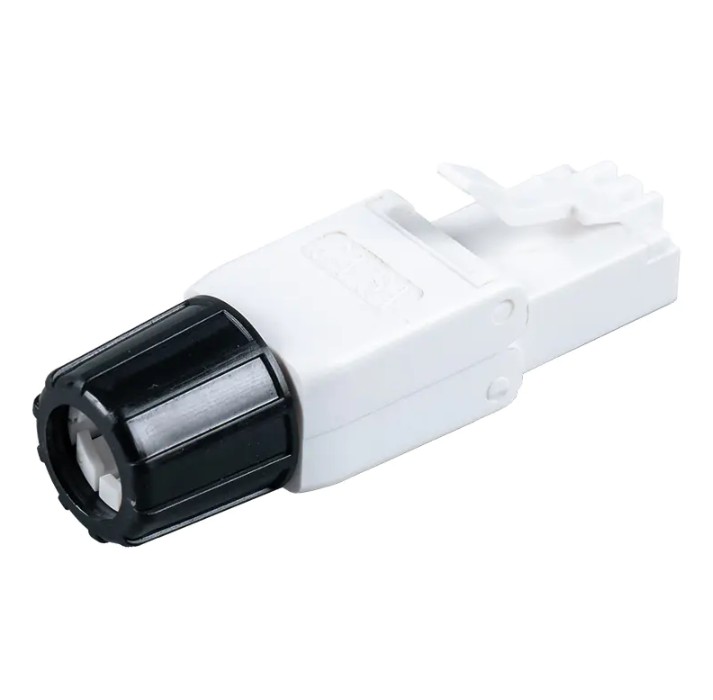
In the structured cabling field, Toolless Connector has gradually replaced traditional RJ45 punch-down connectors, becoming the mainstream choice for data centers, enterprise offices, and FTTx access scenarios. The core reason lies in its ability to reduce single-port installation time from 3 to 5 minutes to under 30 seconds, increase port pass rates to above 99.5%, and eliminate dependency on professional punch-down tools. For medium-to-large projects exceeding 200 ports, this efficiency gain means construction cycles can be compressed from days to hours, with comprehensive cost advantages fully realized within 12 to 18 months.
This article provides a systematic comparison between Toolless Connector and traditional RJ45 punch-down connectors across four dimensions: installation efficiency, protection ratings, application scenarios, and maintenance costs, along with a selection decision framework.
Installation Efficiency Comparison: Quantitative Analysis of Time and Labor Costs
Installation efficiency represents the most intuitive advantage of Toolless Connector. The following data is based on a typical medium-sized data center deployment scenario with 500 ports:
| Comparison Dimension | Toolless Connector | RJ45 Punch-Down Connector |
|---|---|---|
| Single-Port Installation Time | < 30 seconds | 3 - 5 minutes |
| Total Labor Hours for 500 Ports (2 Technicians) | 4 - 5 hours | 25 - 30 hours |
| Tool Dependency | No professional tools required | Requires punch-down tool, wire stripper |
| Personnel Skill Requirements | Basic training sufficient | Requires proficient punch-down technique |
| First-Time Pass Rate | > 99.5% | Approximately 92% - 95% |
| Rework Rate | < 0.5% | 5% - 8% |
As clearly shown in the table data, Toolless Connector holds overwhelming advantages in installation efficiency. Traditional RJ45 punch-down connectors demand high levels of force control and wire sequence memorization from operators, with uneven force easily causing poor contact. In contrast, Toolless Connector utilizes spring-press or snap-lock mechanisms to minimize human error. For机房 environments requiring frequent topology adjustments, the modular plug-and-play design of Toolless Connector also supports hot-swapping of ports without re-termination.
Protection Rating Comparison: From Indoor Offices to Harsh Outdoor Environments
Protection ratings represent a critical indicator that cannot be overlooked when selecting connectors. Significant differences exist between Toolless Connector and RJ45 punch-down connectors in terms of protection capabilities, particularly in outdoor and industrial scenarios.
Protection Advantages of Toolless Connector
The design of Toolless Connector is inherently better suited for applications requiring high protection levels. Through precision injection-molded sealing structures and snap-lock mechanisms, Toolless Connector can achieve IP68 protection ratings, meaning:
- Complete dust protection: Long-term operation unaffected by sand, dust, or particulate intrusion
- Water immersion resistance: Capable of continuous operation at 1.5 meters water depth for over 30 minutes
- Corrosion resistance: Engineered with UV-resistant and corrosion-resistant plastics suitable for prolonged outdoor exposure
Protection Limitations of RJ45 Punch-Down Connectors
Due to their open structure and reliance on manual punching, traditional RJ45 punch-down connectors typically achieve only IP20 to IP44 protection ratings. This means they can only withstand minor solid particle intrusion and water splashing, unable to adapt to outdoor rain, industrial dust, or underground humid environments. In FTTx outdoor access, industrial automation, and energy/power scenarios, RJ45 punch-down connectors require additional protective housings, increasing system complexity and cost.
| Protection Indicator | Toolless Connector | RJ45 Punch-Down Connector |
|---|---|---|
| Maximum Protection Rating | IP68 | IP20 - IP44 |
| Dust Protection | Complete dust protection | Protection against large solid particles |
| Water Protection | 1.5m depth / 30 minutes | Splash water protection |
| Temperature Range | -40°C to +85°C | -10°C to +60°C |
| UV Resistance | Supported | Not supported |
| Applicable Environments | Outdoor, industrial, underground | Indoor offices, standard server rooms |
In-Depth Application Analysis: From Data Centers to FTTx Outdoor Access
High-Density Cabling in Data Centers
In data center environments, per-cabinet port density has evolved from 24 ports to 96 to 144 ports or higher. The compact design of Toolless Connector enables higher-density port deployment within 1U of space. More importantly, as networks evolve from 10G to 25G/40G, Toolless Connector supports rapid replacement with higher-specification shielded modules without re-cabling. In contrast, RJ45 punch-down connectors are not only time-consuming to install in high-density scenarios but also risk damaging adjacent port cables through frequent punching operations.
FTTx Outdoor Fiber Access
In FTTH (Fiber to the Home) and FTTB (Fiber to the Building) deployments, the IP68 protection rating of Toolless Connector allows direct installation in outdoor fiber distribution boxes and wall-mounted patch enclosures without additional sealing. After field technicians complete fiber splicing, they can directly insert the Toolless Connector into the port to complete encapsulation, without waiting for adhesive curing, significantly shortening deployment cycles. RJ45 punch-down connectors in such scenarios must be paired with protective housings, increasing system complexity and potential failure points.
Industrial Automation and Energy/Power
Cabling systems in industrial scenarios face multiple challenges including vibration, dust, electromagnetic interference, and extreme temperatures. The all-metal shielded version of Toolless Connector can suppress external electromagnetic interference (EMI) to below -40 dB, while supporting a wide operating temperature range of -40°C to +85°C, ensuring stable operation of industrial Ethernet protocols (Profinet, EtherCAT, etc.). RJ45 punch-down connectors are virtually unusable in such environments and must rely on additional protection and shielding measures.
Maintenance Cost and Lifecycle Analysis
Beyond initial installation costs, the long-term maintenance costs of connectors also impact a project's total cost of ownership (TCO). The differences between Toolless Connector and RJ45 punch-down connectors in this dimension are equally significant.
Maintenance Advantages of Toolless Connector
- Modular replacement: When a port fails, simply remove the old module and insert a new one, reducing maintenance time from 30 minutes to 2 minutes
- Insertion life: Toolless Connector maintains stable performance through over 750 insertion/removal cycles
- Damage-free removal: Replacement does not damage cables, avoiding re-cabling costs
- Standardized compatibility: Supports SC, LC, and other fiber interface types, facilitating system upgrades
Maintenance Limitations of RJ45 Punch-Down Connectors
Once an RJ45 punch-down connector is terminated, any subsequent replacement or adjustment requires cutting the cable and re-punching. This means:
- Each maintenance operation shortens the available cable length, and multiple maintenance cycles may require complete cable replacement
- Re-punching requires on-site professional personnel, increasing labor costs and response times
- Punching operations may interfere with adjacent ports, increasing secondary failure risks
Selection Decision Framework: How to Match the Optimal Solution for Your Project
When choosing between Toolless Connector and RJ45 punch-down connectors, project decision-makers should conduct systematic evaluations across the following dimensions:
Project Scale and Port Quantity
For medium-to-large projects exceeding 200 ports, the comprehensive cost advantages of Toolless Connector become significantly apparent. Although per-module procurement costs are slightly higher than traditional punch-down products, the saved labor hours, reduced rework rates, and maintenance convenience typically recover the incremental investment within 12 to 18 months after project delivery. For small projects (fewer than 50 ports), RJ45 punch-down connectors still hold certain initial cost advantages.
Deployment Environment and Protection Requirements
Environmental assessment is the first step in selection:
- Indoor office environments: RJ45 punch-down connectors can meet basic needs, but Toolless Connector still offers higher installation efficiency
- Data center server rooms: Toolless Connector is the superior choice, especially in high-density patch panels and environments requiring frequent topology adjustments
- Outdoor / industrial environments: The IP68 protection rating of Toolless Connector makes it the only viable choice
Maintenance Frequency and Upgrade Planning
If a project requires frequent port function adjustments or plans network upgrades within the next 3 to 5 years, the modular design of Toolless Connector will significantly reduce long-term maintenance costs. Conversely, for one-time deployments with long-term static networks, the initial cost advantages of RJ45 punch-down connectors may be more attractive.
Industry Trends: Evolution Directions for Toolless Connector Technology
Looking ahead, the Toolless Connector and connectivity technology industry is evolving in three clear directions:
Continuous Speed Escalation: As 400G Ethernet standards gradually take hold, bandwidth requirements for connection components will further increase. Next-generation Toolless Connectors will need to achieve higher signal integrity within smaller physical footprints, posing greater demands on materials science (such as low-loss PCB substrates) and contact design.
Intelligent Integration: Some high-end Toolless Connectors have begun integrating port status monitoring capabilities, displaying real-time connection status, transmission rates, and fault alerts through LED indicators or network management interfaces. This "visualized connectivity" capability will significantly shorten troubleshooting time.
Green Energy Orientation: The proliferation of PoE (Power over Ethernet) technology means Toolless Connectors must not only transmit data but also carry electrical power. The new PoE++ (802.3bt) standard supports single-port output of 90W, presenting new challenges for connector thermal design and current-carrying capacity. Simultaneously, the industry is exploring more environmentally friendly material solutions, such as halogen-free flame-retardant housings and recyclable metal plating.
Contact Us
Your email address will not be published. Required field are marked*


-
 No. 588, Xiaolin Avenue, Xiaolin Town, Cixi City, Zhejiang Province
-
 [email protected]
-
 +86-574-63507962
-
 +86-15988643730
Copyright Ningbo Betterbell Telecommunication Equipment Co., Ltd. All rights reserved. Structured Cabling Solutions Manufacturer Network Cabling Products Supplier
