

 English
 Deutsch
 Español
 русский

Home · News · Industry News · What Is an OEM Cable Manager and Why Does It Matter for Modern Infrastructure?
Industry News
What Is an OEM Cable Manager and Why Does It Matter for Modern Infrastructure?
2026-05-15Content
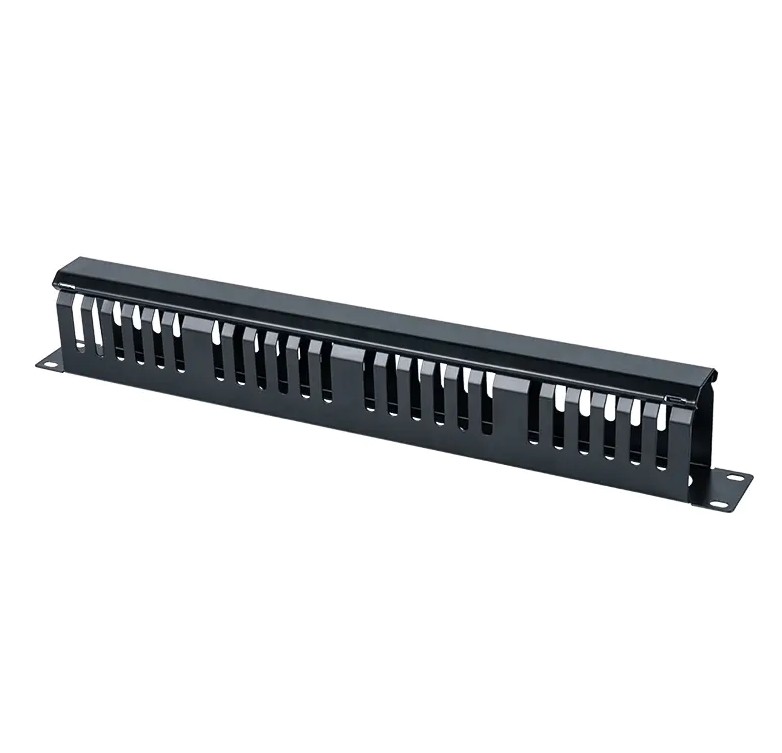
An OEM Cable Manager (Original Equipment Manufacturer cable management unit) has become an indispensable infrastructure component in modern data centers, enterprise server rooms, and industrial communication environments. Its core function is to transform disorganized power and network cables into an orderly, maintainable cabling system through physical isolation and structured routing. Based on industry practice, implementing standardized Cable Managers can increase cabling density by more than 40% while reducing troubleshooting time caused by cable tangling by approximately 60%. For OEM manufacturers, this product is not merely a hardware accessory—it is a critical component that demonstrates system integration capabilities and engineering sophistication.
Core Technical Architecture of OEM Cable Managers
Independent Channel Design: A Physical Barrier Against EMI
High-end OEM Cable Managers universally adopt a separated-channel structure, using physical partitions to completely isolate power cables from data cables. This design directly addresses the mandatory spacing requirements outlined in standards such as GB 50381. Test data indicates that within a standard 1U rack space, dual-channel Cable Managers can reduce electromagnetic interference (EMI) from power lines on Cat6A and higher-grade network cables by 15dB to 20dB, significantly ensuring stability for 10Gbps and higher-speed transmissions.
Material Selection: The Performance Trade-off Between Metal and Plastic
Material selection for OEM Cable Managers directly determines their application scenarios. Metal variants (such as cold-rolled steel and aluminum alloy) offer superior structural strength and EMI shielding effectiveness. A single metal cable organizer can bear 5kg to 8kg of cable load without deformation, making them ideal for backbone cabling in data centers. Plastic variants (such as ABS and flame-retardant PC) leverage their 30% to 50% lighter weight advantage, making them more suitable for front-end office networks or wall-mounted installations with space constraints. OEM manufacturers typically offer dual-material options based on the target customer's deployment environment.
| Comparison Dimension | Metal Material | Plastic Material |
|---|---|---|
| Structural Strength | High, 5-8kg load capacity | Medium, 2-3kg load capacity |
| EMI Shielding | Excellent, 15-25dB attenuation | No shielding capability |
| Weight | Heavier, ~400-600g per 1U | Lightweight, ~200-350g per 1U |
| Application Scenarios | Data centers, industrial environments | Office networks, small server rooms |
Industry Applications and Real-World Deployment
Data Centers: Guardians of High-Density Cabling Order
In large-scale data centers housing over 500 servers, a single row of cabinets can contain thousands of front and rear cables. OEM Cable Managers, installed in 1U or 2U rack-mounted configurations and paired with finger-style or D-ring structures, secure fiber and copper cables in layered arrangements. Actual deployment data shows that cabinets without Cable Managers require an average of 45 minutes to locate a faulty cable, whereas standardized cable management solutions can compress this time to under 10 minutes.
Industrial Communications: Reliability Validation in Harsh Environments
Industrial automation scenarios impose more stringent requirements on Cable Managers. In cabling systems connecting PLCs, HMIs, and sensor networks, OEM Cable Managers must meet IP20 or higher protection ratings and tolerate operating temperature ranges from -20°C to 60°C. Some industrial-grade products also integrate grounding terminals to ensure continuity of shielded cable grounding—particularly critical in variable frequency drive (VFD) peripheral cabling, where they can suppress common-mode interference below standard thresholds.
Enterprise Offices: End-to-End Management from Server Room to Desktop
In modern enterprise office networks, the proliferation of Power over Ethernet (PoE) technology means a single network cable simultaneously carries data and electrical power. The value of OEM Cable Managers in this scenario extends beyond aesthetics to minimum bend radius control (typically requiring no less than 4 times the cable outer diameter), thereby extending PoE cable service life. For office floors deploying IP phones, wireless access points, and surveillance cameras, standardized cable management solutions can reduce post-deployment maintenance tickets by approximately 25%.
OEM Customization: From Standard Component to Integrated Solution
Mature OEM Cable Manager suppliers have evolved beyond pure hardware manufacturing to provide customized cabling solutions. Customization scope includes:
- Personalized cutout dimensions and positions to accommodate non-standard terminal modules
- Color scheme customization (such as specific RAL color codes matching corporate VI standards)
- Identification system integration, including pre-printed port numbers or QR code label positions
- Special structural accessories such as brush strips, Velcro fastening straps, or sliding rails
This flexible production capability enables OEM manufacturers to serve telecommunications equipment manufacturers, system integrators, and specialized equipment sectors, meeting full-cycle demands from small-batch prototyping to large-scale delivery.
Selection Criteria: A Systematic Evaluation Framework
Purchasers evaluating OEM Cable Managers should establish a systematic technical assessment framework rather than focusing solely on unit cost. Core evaluation dimensions include:
| Evaluation Dimension | Key Metric | Qualified Baseline |
|---|---|---|
| Structural Compatibility | Rack Unit (U) specification | Compliant with EIA-310-D standard |
| Flame Retardancy | UL94 flame rating | V-0 or higher grade |
| Surface Treatment | Coating thickness and adhesion | ≥60μm, cross-cut test ≥4B |
| Certification System | ISO 9001, CE, RoHS | Certificates within validity period |
| Customization Response | Sampling cycle and MOQ | ≤15 working days |
It is particularly noteworthy that Coating process directly impacts product lifespan in humid or salt-spray environments. Premium OEM suppliers employ epoxy powder coating or electrophoretic painting, whose corrosion resistance can exceed conventional spray painting by more than 3 times.
Future Trends: Intelligence and Modularity Reshaping Cable Management
As data centers evolve toward intelligent operations and maintenance, OEM Cable Managers are undergoing technological iteration. Frontier trends include:
- Integration of RFID or QR code identification systems for digital tracking and lifecycle management of cable assets
- Modular quick-release structures supporting cable addition and removal without service interruption
- Hybrid cable management solutions compatible with liquid cooling pipelines, addressing both thermal and cabling demands of high-density compute nodes
- Compliance with TIA-942-B standards for cabling pathway redundancy and scalability requirements
For OEM manufacturers, these trends signify a product definition shift from "passive cable organization tool" to "active infrastructure component." Suppliers capable of integrating their offerings into the customer's overall cabling architecture during the design phase will gain significant competitive advantage.
Contact Us
Your email address will not be published. Required field are marked*


-
 No. 588, Xiaolin Avenue, Xiaolin Town, Cixi City, Zhejiang Province
-
 [email protected]
-
 +86-574-63507962
-
 +86-15988643730
Copyright Ningbo Betterbell Telecommunication Equipment Co., Ltd. All rights reserved. Structured Cabling Solutions Manufacturer Network Cabling Products Supplier
