

 English
 Deutsch
 Español
 русский

Home · News · Industry News · How to understand Betterbell's communication accessory solutions?
Industry News
How to understand Betterbell's communication accessory solutions?
2026-02-06Content
- 1 What is a Face Plate?
- 2 What is the main role of a Face Plate in communication equipment?
- 3 Does the Face Plate support installation with different sized fiber optic adapters (SC/LC/FC)?
- 4 What specific communication equipment is a Box Mounting Box typically used to install?
- 5 Is the Box Mounting Box wall-mounted or freestanding?
- 6 What is the main material of the Bottom (Base)?
- 7 Does the mounting box have internal lightning protection?
- 8 Is the wiring method for the Box Mounting Box screw-in or push-pull?
Ningbo Betterbell (BTBL), as a professional manufacturer of communication face plates and a factory specializing in custom back boxes and mounting boxes, provides a complete connection system from face plates to bottom boxes and mounting boxes.
What is a Face Plate?
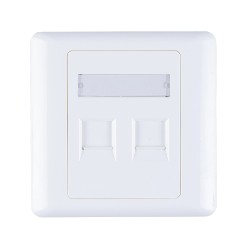
A face plate is an indispensable front-end accessory in a communication system, primarily responsible for organizing and protecting interfaces.
- Interface Reception and Adaptation: As a face plate, it secures and protects various interface ports (such as Keystone modules), ensuring safety during insertion and removal and preventing external interference from affecting fiber optic or network connections.
- Aesthetics and Professionalism: Using BTBL's high-quality face plates provides a uniform and clean appearance, enhancing the professionalism of the computer room or office environment.
- Structured Cabling Foundation: Face plates are the entry or exit point of a structured cabling system, used in conjunction with patch panels to build a stable communication network.
- Materials and Durability: Manufactured with high-strength materials, it features dustproof and waterproof properties, making it suitable for various environments.
| Key Point | Description |
| Interface Accommodation | Secures and protects Keystone modules, fiber adapters, etc. |
| Aesthetic Appearance | Provides a uniform, tidy environment for server rooms/offices. |
| Cabling Foundation | Serves as the entry/exit point for structured cabling systems. |
| Material Characteristics | Dustproof, waterproof, and impact-resistant. |
What is the main role of a Face Plate in communication equipment?
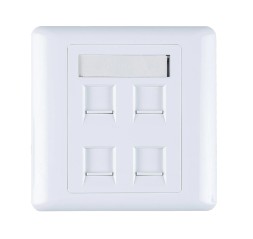
The face plate is not merely a decorative element; it serves as the "command center" for the connected system.
- Standardized Management: Centralized management of numerous network ports is achieved through standardized face plate specifications (such as a standard 19-inch rack mount).
- Electromagnetic Interference Protection: The face plate effectively shields against external electromagnetic interference, preventing signal attenuation and data loss.
- Load Balancing: A well-planned face plate layout balances power and heat loads within the equipment room, extending equipment lifespan.
- Security Assurance: Securely fixing the face plate prevents accidental port detachment or damage, ensuring network continuity.
| Key Point | Description |
| Standardized Management | Standard rack specifications for centralized management. |
| Interference Protection | Shields against electromagnetic interference to reduce signal attenuation. |
| Load Balancing | Balances power and heat dissipation loads. |
| Connection Security | Prevents ports from falling off or being accidentally damaged. |
Does the Face Plate support installation with different sized fiber optic adapters (SC/LC/FC)?
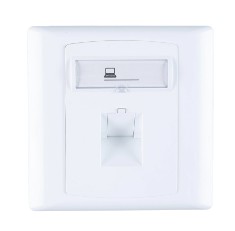
- Due to BTBL's product characteristics, the face plate offers high compatibility.
- Modular Design: BTBL face plates typically employ a modular design (such as Keystone modules), allowing users to select and plug in different specifications of fiber optic adapters, such as SC, LC, or FC, according to their needs.
- Customization: As an OEM manufacturer, BTBL supports customizing fiber optic adapter panels of different sizes according to customer needs to meet specific application scenarios.
- Compatibility Guarantee: Whether single-fiber or multi-fiber configuration, the panel provides robust support and protection.
- Multi-Port Configuration: The panel can be configured as single-port, dual-port, or multi-port, flexibly meeting the high-density requirements of data centers or industrial communications.
| Key Point | Description |
| Modular Design | Supports Keystone modules of SC, LC, FC, and other specifications. |
| Custom Service | OEM can customize plates of different sizes according to needs. |
| High Compatibility | Compatible with both single-fiber and multi-fiber configurations. |
| Multi-Port Options | Supports single-port, dual-port, or high-density multi-port configurations. |
What specific communication equipment is a Box Mounting Box typically used to install?
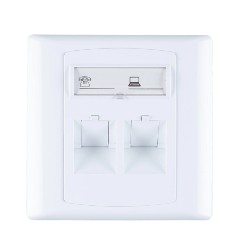
- A Box Mounting Box is a specialized container for housing communication equipment.
- Fiber Optic Patch Box: Primarily used to install key fiber optic communication equipment such as fiber optic adapters, fiber optic splitters, and fiber optic patch panels.
- Connection Point Protection: Used to secure and protect connection points such as Keystone Jacks and Patch Panels, preventing loosening or detachment.
- Outdoor and Rack Use: Suitable for waterproof and dustproof installation in outdoor environments, as well as internal cabling management within racks.
- Cable Access Point: Serves as a transition point for cable and equipment connections, ensuring connection stability and reliability.
| Key Point | Description |
| Fiber Devices | Fiber adapters, splitters, etc. |
| Connection Blocks | Keystone Jacks, Patch Panels. |
| Protection Points | Transitional protection between cables and devices. |
| Applicable Environments | Suitable for outdoor waterproof or internal rack installations. |
Is the Box Mounting Box wall-mounted or freestanding?
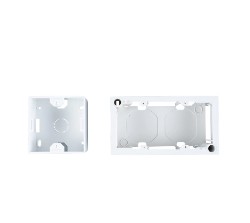
- BTBL offers multiple installation options to suit different installation needs.
- Wall-Mounted: Suitable for fixed installation on the side wall of a server rack, wall, or in a server room, saving floor space and facilitating maintenance.
- Free-Standing: Suitable for scenarios requiring independent placement, such as on a server room floor or specific equipment rack.
- Diverse Mounting Holes: The mounting boxes are typically designed with pre-drilled screw holes or clips for quick locking or disassembly.
- Compatible with Standardized Racks: Some mounting boxes are sized to fit standard 19-inch server racks and can be directly slid into the rack.
| Key Point | Description |
| Wall-Mounted | Suitable for rack sidewalls, walls. |
| Free-Standing | Suitable for placement on server room floors or equipment racks. |
| Easy Installation | Pre-drilled screw holes or clips for quick locking. |
| Compatibility | Conforms to standard 19-inch rack dimensions. |
What is the main material of the Bottom (Base)?
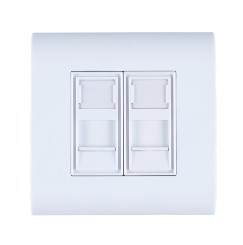
- The Bottom is the foundation component of the mounting box, and its material directly affects the product's durability.
- High-Strength ABS Plastic: Most BTBL Bottoms are made of high-strength engineering plastics such as ABS or PC (polycarbonate), which are lightweight and have high impact resistance.
- Corrosion Resistance: The plastic material is naturally corrosion-resistant, suitable for humid or highly corrosive industrial environments.
- Fire Retardant: Some high-end product bases undergo flame-retardant treatment, meeting the safety standards of the telecommunications industry.
- High-Precision Injection Molding: Manufactured using high-precision injection molding technology, ensuring consistency in screw hole positions and slot dimensions.
| Key Point | Description |
| ABS/PC Plastic | Mainstream high-strength engineering plastics. |
| Corrosion-Resistant | Naturally corrosion-resistant, suitable for industrial environments. |
| Flame-Retardant | High-end products have flame-retardant treatment. |
| High Precision | Injection molding ensures dimensional consistency. |
Does the mounting box have internal lightning protection?
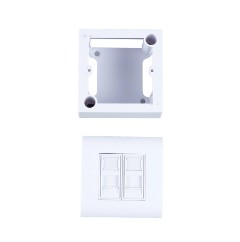
- Based on BTBL's product positioning, targeting industrial and data center needs, its mounting boxes typically feature electromagnetic compatibility (EMC) design.
- Shielding Design: High-end mounting boxes may employ a metal shielding layer or conductive adhesive coating to reduce external electromagnetic interference.
- Grounding Hole: Some models have a pre-drilled grounding hole, allowing users to connect a lightning protection ground wire or grounding device.
- Moisture and Dust Proof: In addition to electromagnetic protection, the mounting box also features moisture and dustproof structures to prevent moisture or dust from entering the internal equipment.
- Non-Mandatory Lightning Protection: While not necessarily equipped with a high-voltage lightning protection device as standard, its structural design is sufficient to withstand ordinary electromagnetic interference and lightning surges.
| Key Point | Description |
| Shielding Layer | High-end boxes may use metal shielding or conductive coating. |
| Grounding Port | Pre-drilled grounding ports for connecting ground lines. |
| Moisture & Dust Protection | Prevents moisture and dust ingress. |
| Interference Resistance | Designed to resist ordinary electromagnetic interference. |
Is the wiring method for the Box Mounting Box screw-in or push-pull?
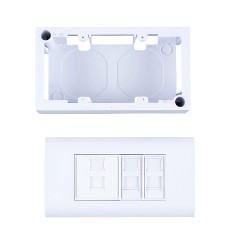
- BTBL's mounting box design emphasizes ease of installation and removal.
- Push-Pull: Most mounting boxes use push-pull or clip-on designs for internal wiring, allowing for quick cable securing or replacement without additional tools.
- Screw-in: For heavy-duty connectors or high-power devices, screw holes may be provided for tightening with a screwdriver.
- Tool-free design: The advantage of push-pull design is that it eliminates the need for a screwdriver, reducing maintenance costs and improving work efficiency.
- Compatible with various cables: Whether it's fiber optic patch cords, Cat6/7 network cables, or power cords, the mounting box provides the corresponding push-pull or crimp structure.
| Key Point | Description |
| Push-In Design | Most use Push-Pull clips for quick connection. |
| Screw Reinforcement | Heavy-duty devices provide screw holes for reinforcement. |
| Tool-Free | Push-in design eliminates the need for screwdrivers. |
| Multi-Cable Compatibility | Supports fiber jumpers, Cat6/7 Ethernet cables, and power cables. |
Contact Us
Your email address will not be published. Required field are marked*


-
 No. 588, Xiaolin Avenue, Xiaolin Town, Cixi City, Zhejiang Province
-
 [email protected]
-
 +86-574-63507962
-
 +86-15988643730
Copyright Ningbo Betterbell Telecommunication Equipment Co., Ltd. All rights reserved. Structured Cabling Solutions Manufacturer Network Cabling Products Supplier
