

 English
 Deutsch
 Español
 русский


Home · News · Industry News · Cat6 Keystone Jack vs Cat6a: Specs, Bandwidth, Shielding, and Cost Differences
Industry News
Cat6 Keystone Jack vs Cat6a: Specs, Bandwidth, Shielding, and Cost Differences
2026-10-16Content
A 24-port panel is specified with Cat6a cable, but the purchase order goes out for Cat6 jacks because they cost less and ship faster. The crew terminates everything correctly, the certifier runs a permanent-link sweep, and the links fail above 300 MHz. Nothing is miswired. The jacks were never part of a Cat6a channel.
Match the jack to the cable. A Cat6 keystone jack is rated to 250 MHz and supports 10GBASE-T over roughly 55 m. A Cat6a keystone jack is rated to 500 MHz and supports 10GBASE-T over the full 100 m channel with far more margin for alien crosstalk. Put a Cat6 jack on Cat6a cable and you own a Cat6 link with expensive cable. Put a Cat6a jack on Cat6 cable and you own a Cat6 link with an expensive jack. The channel is only as good as its weakest component.
Cat6 and Cat6a Keystone Jacks Side by Side
| Parameter | Cat6 keystone jack | Cat6a keystone jack |
|---|---|---|
| Rated bandwidth | 250 MHz | 500 MHz |
| 10GBASE-T support | Up to about 55 m | Full 100 m channel |
| Alien crosstalk margin | Limited; adjacent jacks need care | Built for PSANEXT and PSAACR-F |
| Shielding options | Unshielded, or shielded for specific jobs | Unshielded, F/UTP and S/FTP widely available |
| Conductor size accepted | Usually 23-24 AWG solid | Usually 22-23 AWG solid |
| Body depth behind the plate | Shorter | Longer; check back box and bend radius |
| Common termination | Punch-down and toolless | Mostly toolless with a pair spacer |
| Relative cost per port | Baseline | Roughly 20-40 percent higher |
| Best fit | 1G access layer, short 10G runs | 10GBASE-T backbones, PoE++, high-EMI sites |
Read the table row by row, not from the price column. Two rows cause the most trouble on site: the conductor size the IDC tower accepts, and the depth the jack body adds behind the wall plate. A Cat6a jack is not a Cat6 jack built to a tighter tolerance; the pair geometry, the compensation network and often the housing all change.
Why the Jack Has to Match the Cable Grade
A category rating is a channel rating. Cable, jack, panel, patch cord and the far-end connector all have to be qualified at the same frequency. When one part is rated at 250 MHz, the channel result collapses to that number no matter how good the rest is.
Return loss is where Cat6 jacks give up first. A Cat6a cable holds a tight impedance profile at 500 MHz, and a Cat6a jack carries an IDC geometry and compensation network built to follow it. Push 500 MHz through a 250 MHz compensation circuit and the reflected energy shows up as a return loss failure, even when insertion loss looks acceptable.
Alien crosstalk is the second gap. A panel full of Cat6 jacks has neither the spacing nor the internal shielding to hold PSANEXT and PSAACR-F at 500 MHz, so the panel becomes the failure point in an otherwise Cat6a installation.
Wire gauge decides the rest. Cat6a cable commonly uses 22-23 AWG conductors while many Cat6 jacks are built around 23-24 AWG, and a thicker conductor forced into a narrow IDC tower can splay the contact. For Cat6 projects end to end, a toolless 180-degree jack keeps terminations repeatable without a punch-down tool:
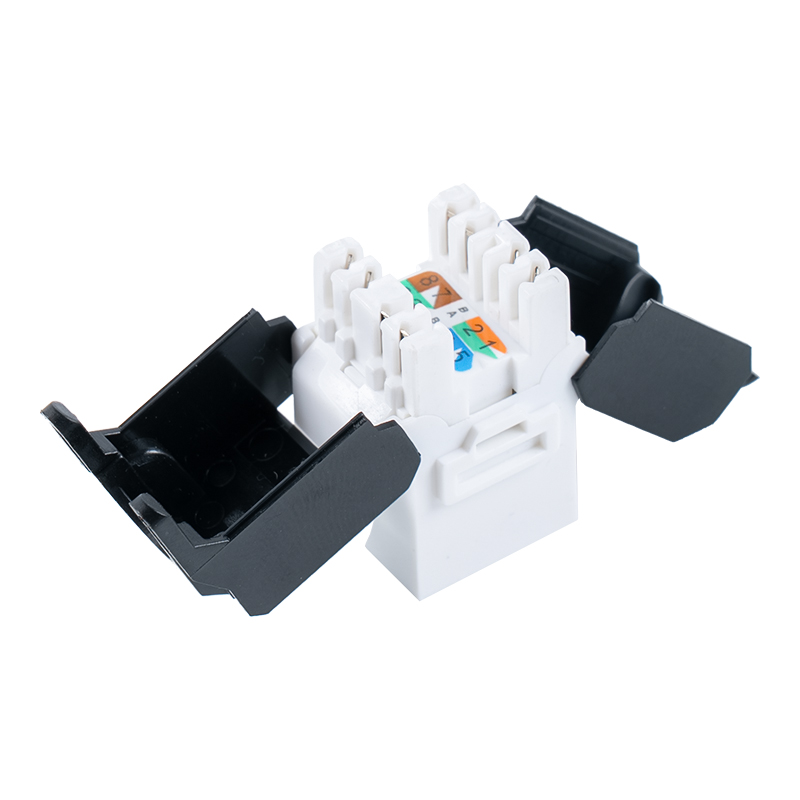 Cat6 Unshielded 180° Toolless Modular Jack, Flip-Open TypeTool-free keystone jack for Cat6 projects, with 180° entry and 22–24 AWG support to keep terminations repeatable in tight panels.View Product →
Physical Differences That Change the Install
Spec sheet differences turn into site problems. These are the ones that cost rework:
- Wire gauge range. A jack rated for 22-26 AWG covers both grades; one limited to 23-24 AWG is a Cat6 part.
- Body depth. Shielded Cat6a jacks are longer, so in a 35 mm back box or shallow trunking the cable bend radius decides whether the plate closes.
- Bundle size. Cat6a S/FTP cable runs about 7.5-8.5 mm in diameter; size the cable manager and the panel entry for it.
- Grounding. A shielded jack only performs when the foil and drain wire bond to a grounded panel or a bonded plate. A floating shield can be worse than an unshielded part.
- Termination and angle. Toolless jacks with a pair spacer cut install time; 90-degree bodies suit shallow boxes and 180-degree bodies suit panels.
- Panel density. Frames designed for Cat6a modules leave more room between ports for larger jack bodies.
Most rework is not a cable fault; it is a jack that does not fit the box, the panel or the conductor. For shielded Cat6a work, a jack with a metal casing and an integrated bracket holds the shield bonded and the body steady while the pairs are dressed:
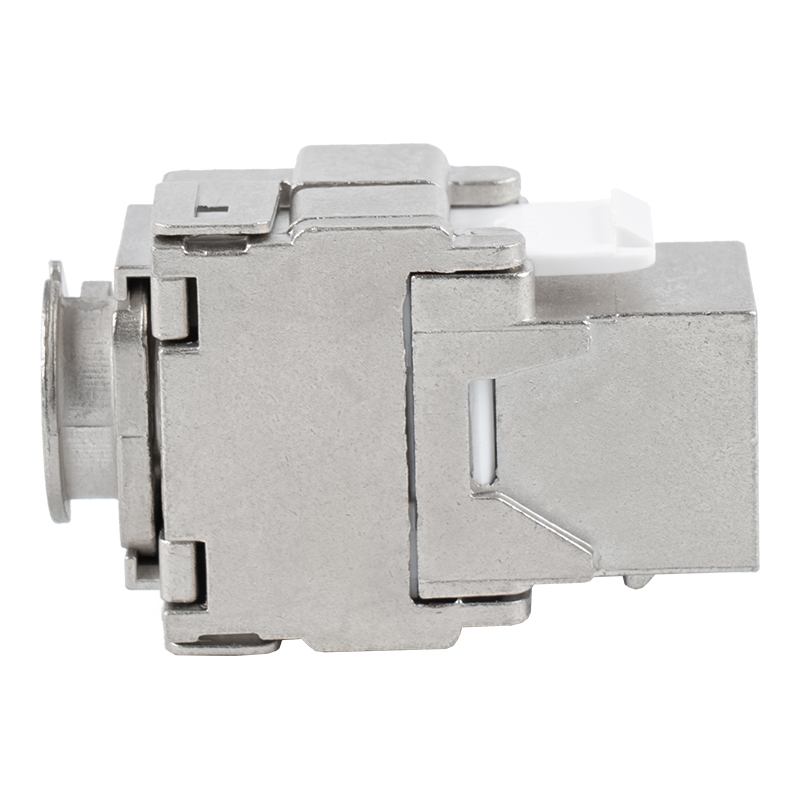 C6A Shielded 180° Tool-less Keystone Jack with BracketShielded Cat6A keystone jack with zinc alloy shell and bracket, offering tool-less 180° termination for stable shield bonding in tight boxes.View Product →
What Happens When You Mix the Two Grades
Standards allow mixing as long as it is documented, but the channel can only be certified to the lowest installed category. Four combinations cover most sites:
- Cat6a jack with Cat6 cable. Backward compatible and it certifies at 250 MHz. Cat6a prices for Cat6 performance.
- Cat6 jack with Cat6a cable. The one to avoid. A gauge mismatch plus a 250 MHz compensation network typically fails a 500 MHz sweep, and no paperwork turns that link into Cat6a.
- Cat6a jack and cable with Cat6 patch cords. The cord is part of the channel, and it is the most common reason a Cat6a link fails the first test.
- Shielded jack with unshielded cable or an ungrounded panel. The shield has nowhere to go. Keep it continuous through the whole path, or stay unshielded.
Test to the lowest category in the channel and label it that way. A documented Cat6 link is a working asset; an undocumented Cat6a link becomes someone else's problem at the next move, add or change.
Cost, PoE and Heat: Where Cat6a Earns the Premium
Cat6a hardware costs more, and not every project needs it. The premium pays back in four situations:
- Distance. Cat6 carries 10GBASE-T to roughly 55 m. If any run needs 10G at 90 m, Cat6a is not optional.
- PoE power levels. Type 2 delivers up to 30 W, Type 3 up to 60 W and Type 4 up to 90 W. Larger Cat6a conductors mean lower DC resistance and less heat in the bundle.
- Bundle temperature. Derating guidance applies to both grades, but Cat6a leaves more headroom in dense trays and conduits.
- Lifespan. If the space will need 10G endpoints within a decade, the material difference usually costs less than re-pulling cable through finished ceilings.
Per port, a Cat6a jack typically runs 20 to 40 percent above a Cat6 jack, before the shielded panel, shielded cords and grounding work. Calculate the difference per port, not per box.
Which Jack Should You Buy?
Match the jack to the cable you have already specified, then check the channel as a whole:
- Office LAN, 1G access layer, runs under 50 m: Cat6 unshielded jacks, panels and cords.
- Wi-Fi 6E or Wi-Fi 7 access point backhaul: Cat6a, because those access points ask for 2.5G, 5G or 10G at the port.
- Data center cross-connects: shielded Cat6a jacks in pre-loaded Cat6a panels, with cable management sized for the larger bundles.
- Industrial or high-EMI areas: shielded Cat6a with bonded grounding, metal casings and bracket or locking options where vibration is a factor.
- Voice and legacy C3 runs: keep them on Category 3 parts and panels and do not borrow data ports for analog voice.
We manufacture both grades, so the recommendation on a quote does not depend on what happens to be in stock. Cat6 and Cat6a keystone jacks are available in 90-degree and 180-degree bodies, shielded and unshielded, toolless and modular, and the customization service covers private labeling, port counts and mixed panel builds for ODM and OEM projects.
The panel matters as much as the jack. A 19-inch 1U shielded frame pre-loaded with Cat6a modules keeps the module, the frame and the grounding in one tested assembly:
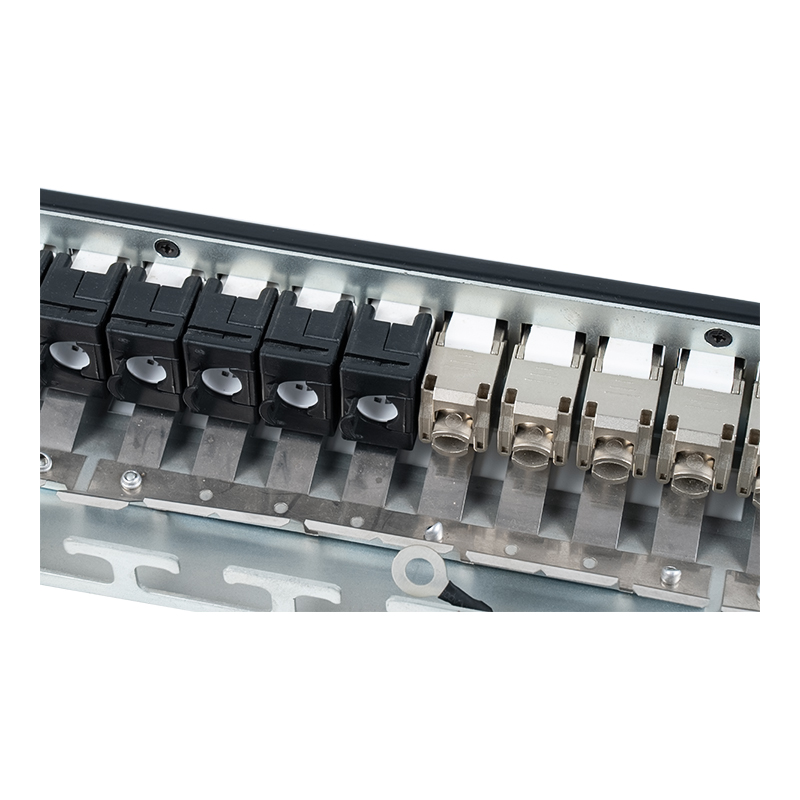 19-Inch 1U 24-Port Shielded Cat6A Patch PanelPre-loaded 24-port shielded patch panel for 19-inch racks, supporting Cat6A 10Gbps and keeping modules, frame, and grounding in one assembly.View Product →
Frequently Asked Questions
Can I use Cat6 keystone jacks with Cat6a cable?
The link usually works for 1G and short 10G runs, but it will not certify at 500 MHz, and the IDC tower may not accept the thicker conductor cleanly.
Can I use Cat6a keystone jacks with Cat6 cable?
Yes. Cat6a parts are backward compatible, and Cat6 cable terminates normally as long as the IDC range covers 23-24 AWG. The channel still certifies at Cat6.
Do I need shielded Cat6a jacks?
Only where there is a real EMI problem and a grounding system that will be bonded at both ends. Unshielded Cat6a is cheaper, faster to install and enough for most office backbones.
Is Cat6a worth it for a home or small office?
Rarely. If no run exceeds 55 m and nothing needs 10G at the port, a Cat6 channel with quality jacks does the job. Cat6a makes sense where the budget is already committed to 10G or PoE++ endpoints.
The decision is simpler than the catalogues suggest: choose the cable grade first, then buy jacks, panels and cords at the same grade, and test the channel to the lowest rated part. A matched Cat6 channel outperforms a mixed Cat6a channel every time, and it still passes certification years later.
If you are checking whether a specific conductor size fits a specific jack, send us the cable datasheet. Our team will confirm the IDC range, panel compatibility and body style before you commit to a full order — just contact us with the project details.
Contact Us
Your email address will not be published. Required field are marked*


-
 No. 588, Xiaolin Avenue, Xiaolin Town, Cixi City, Zhejiang Province
-
 [email protected]
-
 +86-574-63507962
-
 +86-15988643730
Copyright Ningbo Betterbell Telecommunication Equipment Co., Ltd. All rights reserved. Structured Cabling Solutions Manufacturer Network Cabling Products Supplier
