

 English
 Deutsch
 Español
 русский

Home · News · Industry News · Cabling Certification Failure Rate: Why Links Fail and How to Reduce Failures
Industry News
Cabling Certification Failure Rate: Why Links Fail and How to Reduce Failures
2026-10-09Content
A project manager gets a 300-point test report back. Twenty-four links failed, and the contractor has already loaded the truck. Eight percent sounds survivable until you price the rework — a failed link is rarely one link's worth of cost. It is a re-termination, a re-test, a schedule slip, and a document set that no longer matches the as-built.
Here is the short version. Cabling certification failure rate is rarely a cable problem. It is the product of three things: termination practice on site, the mechanical tolerance of the connector hardware, and how the test itself was configured. The one you control most easily is the one crews routinely skip. Experienced installers hold first-pass failure around 5 to 10 percent on unshielded Cat6. On shielded Cat6a, run by a crew with no shielding discipline, the same number climbs past 20 percent and sometimes beyond 30 percent. Installers who describe re-terminating one link four times before it passes are not describing a bad batch of cable. They are describing a termination process that never got corrected.
What a Certification Failure Rate Actually Measures
Certification is not a continuity check. A certifier sweeps the link across a frequency range and scores it against TIA-568 or ISO/IEC 11801 limits. A verification tester only confirms wiring continuity and pair order. That gap explains the most common complaint in the field: a link that passed a simple tester and then failed certification. Both results were correct. They answered different questions.
The second thing that makes failure rates hard to compare is that certification is all-or-nothing across a parameter set. Insertion loss, near-end crosstalk (NEXT), power-sum NEXT (PSNEXT), far-end crosstalk, return loss, attenuation-to-crosstalk ratio and propagation delay all have to hold. A single parameter outside its margin fails the whole link.
There is also a rule that surprises people who are new to reading reports. Under the widely applied 3 dB rule, a link can pass with a negative NEXT margin, as long as its insertion loss sits more than 3 dB inside the limit. So the link with the ugliest NEXT trace on the report may pass, while the link next to it with a cleaner NEXT trace fails because it runs four metres longer and insertion loss eats the entire margin. Length and loss beat crosstalk on short runs. Crosstalk beats length on long ones.
Finally, channel and permanent link are not the same measurement. A channel test includes the patch cords at both ends. A permanent link test does not. If the specification calls for permanent link and the contractor submits channel data, your failure rate changes without a single cable moving. Put the test configuration in the contract before the first box is opened. If you want to see how the whole cabling system fits together before you write that specification, this overview of network cabling is a reasonable starting point.
Realistic Failure Rates by Cable Class and Crew
The ranges below come from field test data and installer reporting, not from controlled laboratory work. Do not treat them as a delivery target. Treat them as a tripwire: if your measured first-pass failure rate is roughly double the figure in the matching row, you have a process problem rather than bad luck.
| Cable class and scenario | Typical first-pass failure | Dominant cause |
|---|---|---|
| Cat3 voice backbone | Under 3% | Parameter limits are far looser |
| Cat5e, office fit-out, experienced crew | 3–8% | Jack termination quality, excessive pair untwist |
| Cat6 unshielded, trained crew | 5–10% | Split pairs, over-cinched cable ties |
| Cat6a shielded, low shielding discipline | 20–40% | Incomplete shield bonding, broken drain continuity |
| Retrofit reusing existing cable | 10–25% | Pre-existing cable damage, links over the length limit |
The Five Causes Behind Most Certification Failures
Before you order a re-pull, work this list in order. Most failed links land in the first two categories, and the first two are also the cheapest to correct.
- Termination defects. Conductors not fully seated in the IDC slot, too much jacket stripped back so pairs lie exposed, or pairs left untwisted further than the connector body allows. All of it looks acceptable to the eye and shows up immediately on a NEXT sweep.
- Split pairs. Pairs 1-2 and 3-6 split across different twisted pairs, or an A-wiring and B-wiring mix at the two ends. A continuity tester will happily report a working link because the DC path is intact, while crosstalk performance collapses.
- Shield and ground continuity. A shielded connector needs 360-degree shield contact and a drain wire that is actually bonded. Partial shield wrap, a drain wire trimmed too short, or a potential difference between the two ends of a link will each fail an otherwise impeccable cable.
- Mechanical stress. Bend radius below the manufacturer minimum, cable ties tightened with a tool, cable dragged over a sharp tray edge. A crushed pair changes the geometry of the twist and therefore the impedance, and the report shows it as elevated return loss or NEXT.
- Test configuration and instrument use. Wrong channel versus permanent link adapter, a patch cord that is not seated, an out-of-calibration certifier, or a coil of slack sitting in a loop beside the rack while the link is measured.
Why Connector and Jack Choice Moves the Number
Connectors and jacks are the cheapest line items in a structured cabling bill of materials. They also decide how much margin a crew has left after a normal day's work. Those two facts rarely sit comfortably together in a procurement meeting.
Angle matters more than most buyers expect. In a shallow back box, a 90-degree termination gives the installer far more room to route pairs than a 180-degree body, and the same technician can produce noticeably different failure rates in the same wall with the two products. A shielded jack with a proper bracket or a flip-open body gives the shield somewhere to land, which is the difference between a link that certifies and a link that fails on shield continuity.
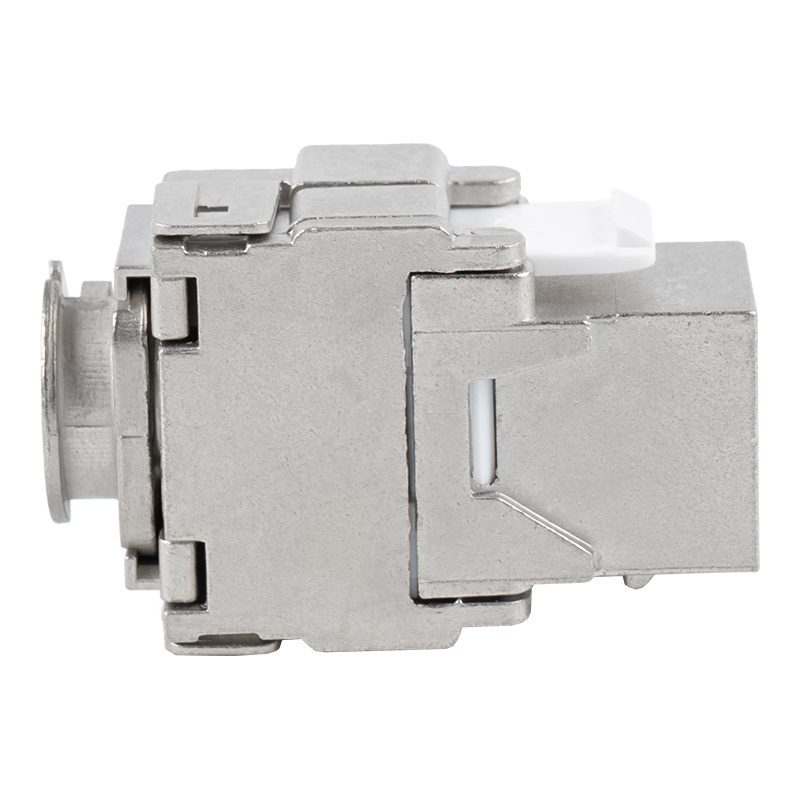 C6A Shielded 180-Degree Tool-Less Keystone Jack with Bracket180-degree angled entry and zinc alloy 360-degree shielding for Cat6A/Cat6 terminations, with dust shutter, locking, 10G and 500 MHz support.View Product →
Field terminations are where repetition shows up. When an installer has to redo a plug two or three times, the conductor ends fatigue, the pair geometry degrades, and the third attempt often certifies worse than the first. Tool-less plug designs with a guided loading sequence reduce the number of attempts per connector. On shielded Cat6a runs, a metal-buckle body that clamps the foil gives a repeatable shield bond instead of a shield that depends on how carefully one person folded it.
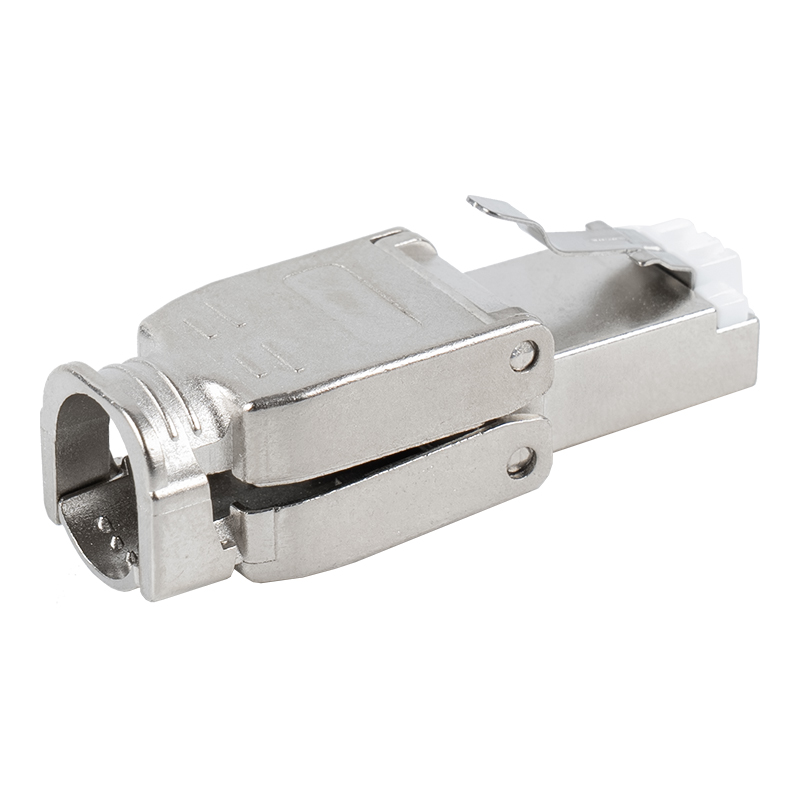 Cat6A Shielded Metal Buckle Toolless RJ45 ConnectorSnap-on shielded 8P8C connector for 10GBase-T and PoE++ cabling, with nickel-plated zinc alloy housing, dust cover, and re-termination support.View Product →
None of this removes the need for a disciplined crew. It removes the excuses. A connector that behaves predictably under a mediocre pair of hands is worth more on a live site than one with a better laboratory spec sheet, because the lab never terminates 400 links in a week.
Field Practices That Take the Failure Rate Down Fastest
These are the interventions that move a first-pass rate the most per hour of effort. None of them require new capital equipment.
- Test as you build, not at the end. A crew that certifies 20 links a day can re-terminate a bad one while the tool bag is still open. A crew that tests 300 links on the last day re-terminates everything at penalty rates.
- Leave a service loop at both ends. One and a half metres of slack costs almost nothing and buys back a failed end that would otherwise need a fresh pull.
- Use only certified patch cords for channel tests. An uncertified cord corrupts the measurement at both ends, and the report gives you no way to separate its contribution from the permanent link's.
- Prove shield continuity before you certify. One grounding check per shielded link catches the failures that only appear in the crosstalk sweep.
- Photograph the terminations before the faceplates go on. Rework disputes are decided by evidence, not memory.
- Keep the rack end consistent. Mixing brands of patch panel across a single cabinet makes it hard to tell a systematic fault from a one-off.
Rack-end hardware deserves the same discipline as the outlet end. A shielded patch panel with pre-loaded Cat6a modules removes one whole variable, because the module is terminated and tested before it reaches the rack.
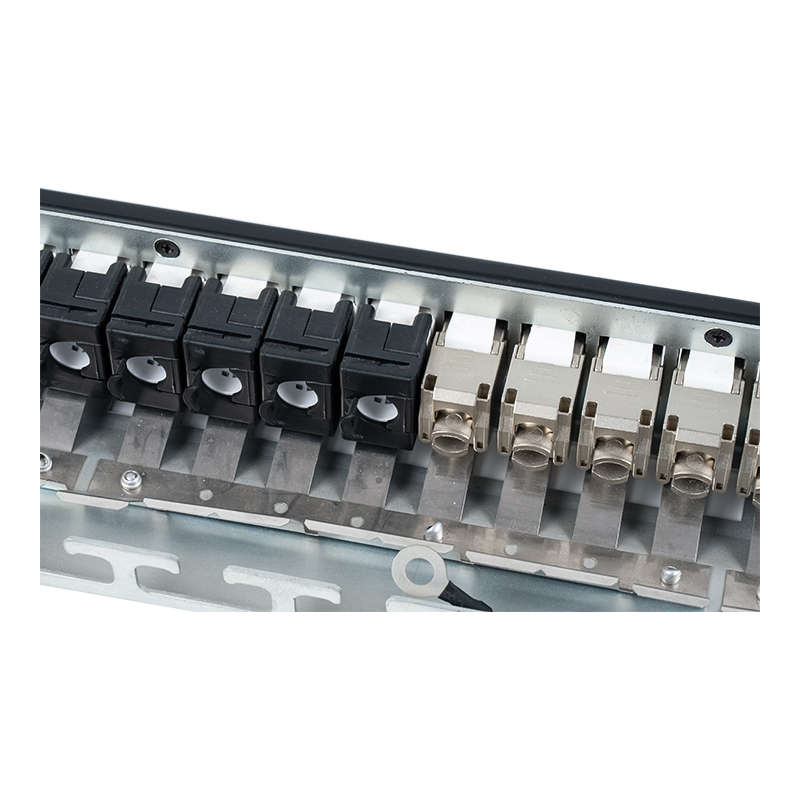 19-Inch 1U 24-Port Shielded Cat6A Patch PanelC6A modules and full shielding for 10 Gbps rack-end termination, with color-coded T568A/T568B wiring, punch-down terminals, and 22–26 AWG support.View Product →
Questions Buyers and Site Leads Ask
Does a high failure rate mean the cable is defective?
Rarely. If a single drum or box fails across several links, suspect the cable. If failures are scattered across different links and different crews, suspect the termination process. The pattern matters more than the count.
Can we re-test the same link and get a different result?
Yes, and that is a signal rather than noise. A link sitting close to a limit boundary can pass on one sweep and fail on the next if the connectors are marginal, slack is coiled near the rack, or temperature has shifted. Links that pass with less than 1 dB of margin should be treated as fragile, not as done.
Why does a link pass a basic tester but fail certification?
Because a basic tester checks continuity and pair order, while certification measures loss and crosstalk across frequency. A link can be electrically continuous and still be unusable at 10GBASE-T.
Where should the failure threshold sit in a contract?
Set it per cable class, not per project, and state the test configuration and the certifier accuracy level alongside it. A rate target without a defined test method is not a specification.
Certification failure rate is a process indicator that happens to be attached to a cable. Fix the termination sequence, choose connectors whose geometry matches the box you are installing into, and test in batches small enough to correct. The number comes down quickly after that. If your project needs connector and rack hardware adapted to a specific channel build, ODM and OEM customization is where that conversation starts.
Contact Us
Your email address will not be published. Required field are marked*


-
 No. 588, Xiaolin Avenue, Xiaolin Town, Cixi City, Zhejiang Province
-
 [email protected]
-
 +86-574-63507962
-
 +86-15988643730
Copyright Ningbo Betterbell Telecommunication Equipment Co., Ltd. All rights reserved. Structured Cabling Solutions Manufacturer Network Cabling Products Supplier
