

 English
 Deutsch
 Español
 русский


Home · News · Industry News · field terminable rj45 plug: Applications, Selection Criteria, and Practical Guidance
Industry News
field terminable rj45 plug: Applications, Selection Criteria, and Practical Guidance
2026-11-06Content
A crew rewiring a warehouse mezzanine has 40 ceiling drops and no reliable way to know each run length in advance. Factory patch cords in 0.5 m increments would leave coils of slack behind the tiles, and crimping ordinary RJ45 plugs onto solid bulk cable is a well-known reliability trap. This is exactly the situation a field terminable RJ45 plug was designed for.
Short version: a field terminable plug is a toolless, IDC-based RJ45 connector that you assemble on the cable end with a cable tie and a flush cutter instead of a crimp tool. Choose it when run lengths are unknown, when a keystone jack plus patch cord will not fit in the available depth, or when the link has to be tested the same shift. Match the plug to the cable category and shield type, keep the untwisted length short, and get the strain relief right before you worry about anything else.
What a Field Terminable RJ45 Plug Actually Is
A field terminable plug looks like a hybrid: an RJ45 nose on the front, an open wire-manager body on the back. Three functional blocks decide whether it works:
- Contact block and IDC slots. Each of the eight conductors is pressed into its own insulation-displacement slot. The slot cuts through the insulation and grips bare copper. No crimp die is involved; closing the housing or pressing the wire manager home supplies the force.
- Wire manager. It holds the four pairs in the 1-2, 3-6, 4-5, 7-8 positions and sets how much jacket enters the body. Most designs are labelled for T568A and T568B.
- Retention and shielding. A cable tie, screw cap or snap-on boot clamps the jacket for strain relief. On shielded versions, a metal shell, a fold-over flap or a drain-wire clamp bonds the foil to the connector body.
The difference from a conventional crimp plug matters. A standard plug uses three-prong contacts intended for stranded patch cable; driving those prongs into solid 23 AWG conductor can nick the wire or leave a high-resistance joint that fails months later. Field terminable plugs are rated for solid 22-26 AWG, and many also accept stranded, which is what makes them usable on horizontal cable.
Where Field Termination Beats a Factory Patch Cord
Field termination pays off in three fairly specific conditions, and it is a poor choice in a fourth.
- Unknown or awkward run lengths. Mezzanine drops, kiosk feeds and late layout changes rarely land on a factory increment. Cutting to length on site removes both the coil behind the ceiling tile and a second site visit.
- Rack-side connections where depth is tight. A keystone jack in a housing plus a moulded boot can project 60-70 mm behind a panel. A straight or 90° field plug often fits where that assembly will not.
- Same-day testing. One technician with side cutters, cable ties and a tester can finish and certify a drop without waiting on a factory lead time.
It is the wrong choice when you need hundreds of identical short jumpers, when the assembly will flex constantly at the connector (stranded factory cords handle repeated movement better), or when the installer has never terminated one and the schedule leaves no room for rework.
Choosing a Field Terminable Plug: Five Points That Decide It
1. Category has to match the cable, not the label
A plug marked Cat6A does not turn Cat5e cable into a Cat6A link. The internal pair spacing and IDC geometry are tuned to a conductor size range and a targeted bandwidth. Buy plugs in the same category as the bulk cable on the pallet, and treat Cat7 and Cat8 assemblies as complete systems: connector, cable and installation quality all have to hold up together.
2. Shielded or unshielded follows the cable
If the cable carries foil or braid, that is F/UTP or S/FTP, use a shielded plug with a metal body plus a foil or drain-wire clamp. Leaving the shield floating at the connector turns the foil into an antenna and typically shows up as a shield-continuity or alien-crosstalk failure during certification. Unshielded plugs are lighter, cheaper and faster to close, which is why ordinary U/UTP office runs use them.
 Cat6A Shielded Toolless RJ45 ConnectorField-terminated shielded module for Cat6A links, with zinc alloy shell and IDC termination for installations where foil or braid continuity must be maintained.View Product →
3. Straight or 90° cable exit
A 90° plug routes the cable along the connector body instead of straight back. That helps behind wall-mounted devices, inside shallow back boxes and in industrial cabinets where a door needs clearance. The trade-off is a slightly longer jacket strip and a bend you still have to respect: most installers keep the first bend at four times the cable diameter for U/UTP.
 Cat7 Shielded Toolless RJ45 Connector, 90-DegreeRight-angle shielded connector for Cat7 field termination, useful where cable must run along the body behind wall-mounted devices or in shallow enclosures.View Product →
4. Conductor size, conductor type and jacket OD
Check three numbers before ordering: the AWG range (commonly 22-26 AWG solid, sometimes stranded as well), the jacket outside diameter the strain relief can clamp (often 5.0-7.5 mm), and whether the design is solid-only. A body built around a 5.5 mm jacket will not grip a 6.8 mm Cat6A cable, and the tension ends up pulling on the IDC slots instead of the jacket.
5. Body style: wings, caps and covers
Small moulded differences matter more than they look. Wings support the cable where it leaves the body, a plastic cover protects the terminations during pulls, a screw or mounting base fixes the plug to a panel or enclosure, and a spring clip relieves stress where vibration is present. For routine unshielded Cat6 office work, a simple winged body is usually all the job needs.
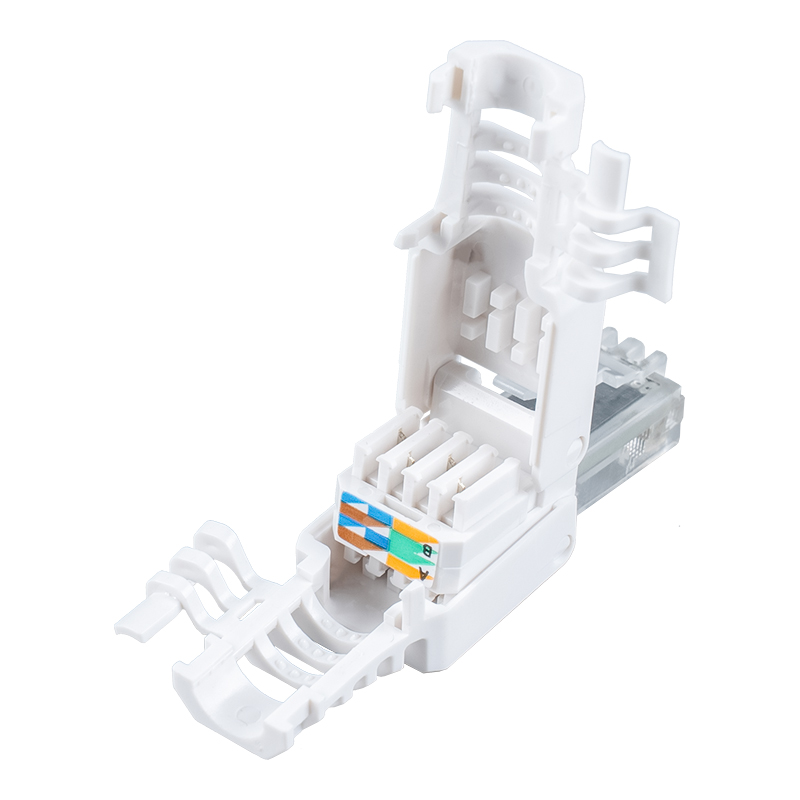 Cat6 Unshielded Toolless RJ45 Connector with WingsWinged UTP connector for routine Cat6 office runs, snapping into panel openings and terminating without crimping pliers for simpler field installation.View Product →
Terminating the Plug in Six Steps
- Cut and strip. Strip 25-30 mm of jacket without nicking the foil or the conductors. On shielded cable, fold the foil back neatly and set the drain wire aside.
- Lay out the pairs. Follow T568B or T568A consistently at both ends. Untwist only as far as the wire manager requires; 13 mm is a common practical ceiling.
- Seat and trim. Press each conductor fully into its slot, then trim flush with side cutters. Conductor stubs hanging past the body are the single most common cause of near-end crosstalk failures.
- Close the body. Squeeze or press until the latch clicks; that press drives the IDC. Some designs expect pliers, so confirm the method before the first termination.
- Lock the strain relief. Tighten the cable tie or screw cap so the jacket, not the conductors, carries any pull. On shielded versions, land the drain wire or foil under the clamp and verify contact.
- Test the link. Run a permanent-link or channel test with the correct adapter. Check wire map and length first, then insertion loss and return loss; for shielded links, confirm shield continuity end to end.
Why Field Terminated Links Fail Certification
- Too much untwisted conductor at the IDC block, which shows up as crosstalk near the connector rather than in the middle of the run.
- Un-trimmed conductor stubs acting like small antennas inside the body.
- Jacket not captured. Tension lands on the terminations, and intermittent opens appear a few months after handover.
- Shield terminated at one end only, which fails continuity while passing a basic wire-map test.
- Wiring code mismatch between the two ends of the same link.
- Overworked IDC slots. Two or three re-terminations is a realistic expectation; after that, fit a new plug rather than trusting the contact.
Field Plug vs Crimp Plug vs Keystone Jack
| Decision point | Field terminable RJ45 plug | Crimp-on RJ45 plug | Keystone jack + patch cord |
|---|---|---|---|
| Tooling | Cable tie, flush cutter, tester adapter | Crimp tool with matching die | Punch-down or toolless, plus faceplate or panel |
| Cable it suits | Solid 22-26 AWG; many accept stranded | Stranded; solid conductor is unreliable | Solid horizontal cable |
| Re-termination | Two to three attempts before contact wear | Cut off and start again | Jack body reusable |
| Depth behind device | Low; 90° versions lower still | Low | Higher, needs housing plus cord |
| Typical use | Exact-length links, retrofit, rack side, industrial | Pre-made stranded leads, lab work | Permanent outlets and patch panels |
FAQ
Can you reuse a field terminable plug?
Usually once or twice, and only if the conductor slots are not deformed. The cost of a plug is small compared with a re-visit, so keep spares on the cart.
Does it work on stranded patch cable?
Many designs do, provided the AWG and jacket OD fall in range. Stranded cable is a better match for cords that will be plugged and unplugged repeatedly, while solid cable suits fixed horizontal runs.
Do you need a special crimp tool?
Normally no. The closing action drives the IDC, and a cable tie plus side cutters covers most designs. Confirm the method on a sample before terminating thirty links.
Can a field plug hit Cat6A or Cat8 performance?
It can, but only as part of a matched system: correct cable, correct shield handling, short untwisted length and a certified test. The connector alone does not set the channel result.
If a project mixes fixed outlets with a moving set of rack-side and industrial links, it makes sense to stock field terminable plugs in the same categories as the bulk cable you already buy. BTBL manufactures toolless plugs from Cat5e through Cat8 in unshielded, shielded, straight and 90° versions, alongside keystone jacks and patch panels for the rest of the channel. ODM and OEM options are set out on the customization page, and samples or specification sheets come through contact.
Contact Us
Your email address will not be published. Required field are marked*


-
 No. 588, Xiaolin Avenue, Xiaolin Town, Cixi City, Zhejiang Province
-
 [email protected]
-
 +86-574-63507962
-
 +86-15988643730
Copyright Ningbo Betterbell Telecommunication Equipment Co., Ltd. All rights reserved. Structured Cabling Solutions Manufacturer Network Cabling Products Supplier
