

 English
 Deutsch
 Español
 русский

Home · News · Industry News · Shielded vs Unshielded Patch Panel—Which One Do You Need?
Industry News
Shielded vs Unshielded Patch Panel—Which One Do You Need?
2026-07-10Content
- 1 What Separates Shielded From Unshielded Construction
- 2 When You Need a Shielded Patch Panel
- 3 When an Unshielded Patch Panel Is the Practical Choice
- 4 Side-by-Side Comparison
- 5 Shielded Patch Panel Product Range
- 6 Grounding Requirements for Shielded Panels
- 7 Common Mistakes When Choosing a Panel Type
- 8 Frequently Asked Questions
Choose a shielded patch panel if your cabling runs near motors, fluorescent ballasts, elevators, welding equipment, MRI rooms, or dense conduit shared with power lines. Choose an unshielded patch panel for standard offices, retail spaces, schools, and residential installs where electromagnetic interference is minimal. The decision comes down to one question: how much electrical noise sits near your cable path. If the answer is a lot, shielding protects signal integrity; if the answer is very little, unshielded hardware delivers the same data performance at a lower cost and with a simpler installation.
What Separates Shielded From Unshielded Construction
Both panel types terminate the same twisted-pair cable and support the same category ratings, but the physical build differs at the port and the back of the panel.
Shielded (STP/FTP) Patch Panels
A shielded panel wraps each port, or the whole panel body, in a metal foil or braid layer that is bonded to the rack earth ground. This shield intercepts electromagnetic interference before it reaches the copper pairs, which keeps crosstalk and external noise from corrupting the signal. Shielded panels require a continuous ground path from the panel to the rack frame and ultimately to the building ground, because an unbonded shield can behave like an antenna and introduce noise rather than blocking it.
Unshielded (UTP) Patch Panels
An unshielded panel relies purely on the twist rate of the internal pairs to cancel out interference. There is no metal shield and no grounding requirement, which makes installation faster and the hardware itself lighter and less expensive. In a low-noise environment, twisted-pair cancellation alone is sufficient to keep a Cat6 or Cat6A link well within its error-rate specification.
When You Need a Shielded Patch Panel
Shielding earns its cost when the installation sits close to a consistent noise source. The table below lists common scenarios pulled from real deployment environments.
| Industrial floors and factories | Variable-frequency drives, welding equipment, and large motors generate strong EMI that unshielded cable cannot reject. |
| Data centers with high port density | Bundled cables running in shared trays create mutual crosstalk; shielding isolates each link. |
| Hospitals and imaging suites | MRI and diagnostic equipment emit interference that can disrupt sensitive network traffic nearby. |
| Buildings with shared power conduit | Any run parallel to electrical conduit for more than a few meters benefits from shielding. |
| 10GBASE-T deployments over Cat6A | Higher frequencies up to 500 MHz are more sensitive to alien crosstalk, so shielded Cat6A panels are common in new 10 Gbps builds. |
When an Unshielded Patch Panel Is the Practical Choice
Most commercial and residential networks never encounter the interference levels described above. For a standard office running Cat6 at 1 Gbps or even 10 Gbps within the 37 to 55 meter distance limit, unshielded patch panels perform identically to shielded ones in terms of data throughput. The savings come from three places: lower panel cost, no grounding hardware or bonding straps, and faster termination since installers do not need to manage a shield connection at every port. For schools, retail stores, small offices, and home networks, unshielded is the standard and cost-effective option.
Side-by-Side Comparison
| Factor | Shielded Patch Panel | Unshielded Patch Panel |
| EMI Rejection | High, blocks external electrical noise | Moderate, relies on pair twist only |
| Grounding Required | Yes, continuous bond to rack earth | No |
| Installation Time | Longer, ground strap and bonding checks needed | Shorter, standard punch-down only |
| Relative Cost | Higher, typically 20 to 40 percent more per port | Lower baseline cost |
| Best Fit | Industrial sites, data centers, 10GBASE-T runs near EMI | Offices, homes, schools, standard commercial cabling |
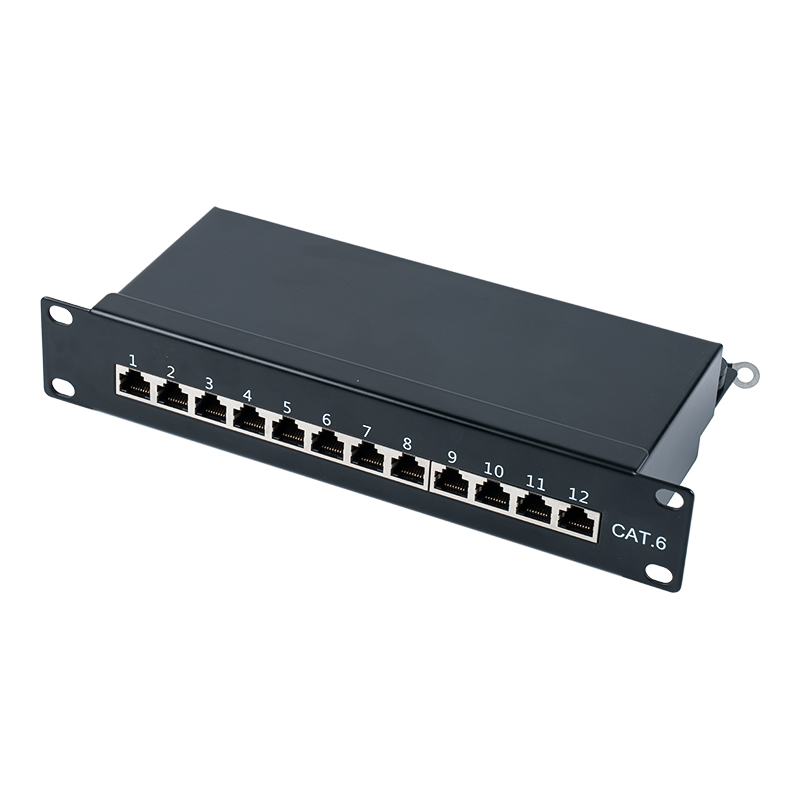
Shielded Patch Panel Product Range
Below is a sample of shielded patch panel formats manufactured for Category 6 and Cat6A cabling, covering port counts from 8 to 24 and rack widths from 10-inch to full 19-inch.
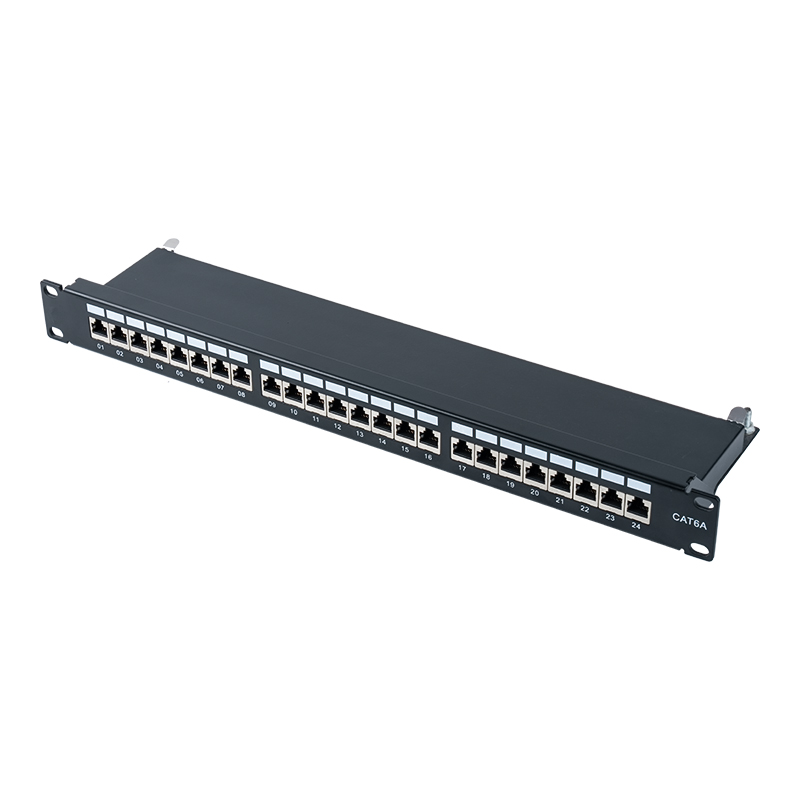
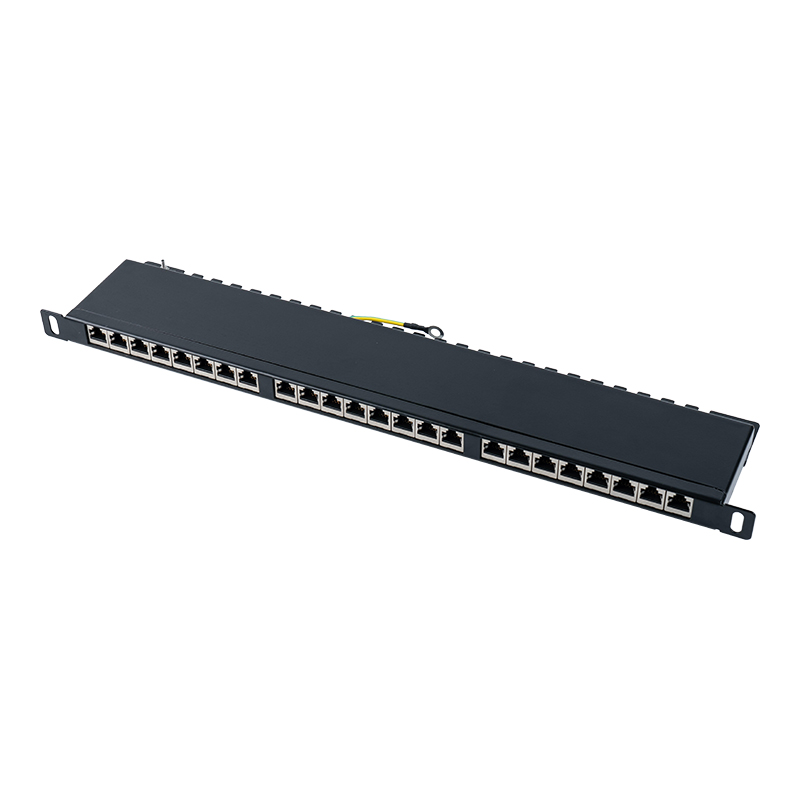
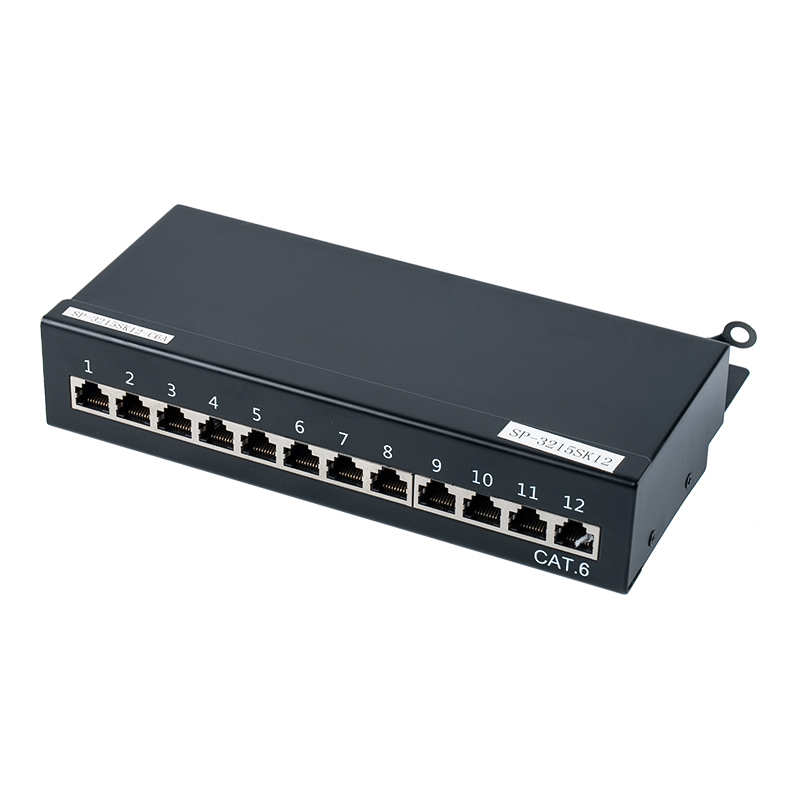
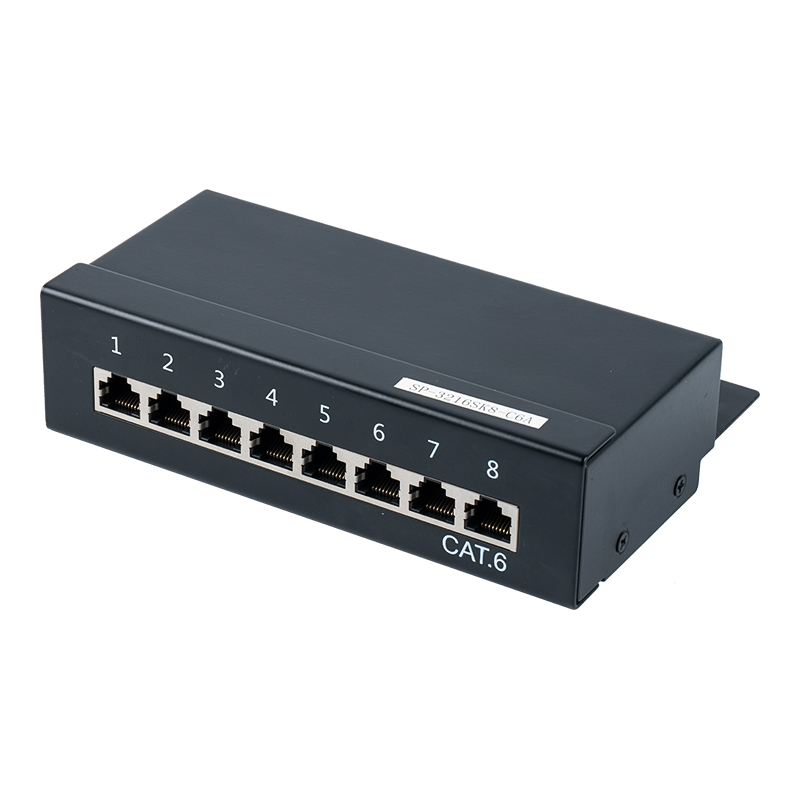
Grounding Requirements for Shielded Panels
A shielded panel only works correctly when the shield has a low-resistance path to earth ground. Skipping this step is the single most common installation error and can make a shielded run perform worse than an unshielded one.
Bonding the Rack
The rack frame itself needs a dedicated ground conductor, typically sized at 6 AWG or larger, run to the building's main grounding busbar.
Bonding Each Panel
Shielded panels use grounding lugs, screws, or braided straps at the panel chassis. Every panel in the rack should bond to the same ground point to avoid ground loops between adjacent panels.
Checking Continuity
After installation, a continuity test between the panel shield and the building ground should read well under 1 ohm. Anything higher points to a loose lug or a missing bonding jumper.
Common Mistakes When Choosing a Panel Type
Two mistakes show up repeatedly in field audits. The first is installing shielded hardware without grounding it, which adds cost without adding protection and can introduce hum or noise pickup. The second is using unshielded panels in a run that shares a tray with three-phase power conduit, which leads to intermittent packet loss that is difficult to diagnose after the fact. Matching the panel to the actual electrical environment, rather than defaulting to one type across an entire building, avoids both problems.
Frequently Asked Questions
Does a shielded patch panel improve speed?
No. Shielding does not raise the maximum data rate of a category rating; it reduces the error rate in noisy environments, which keeps the link running at its rated speed instead of dropping to a lower negotiated speed.
Can shielded and unshielded panels be mixed in the same rack?
Yes, but the shielded ports must still use shielded patch cords and keystone jacks end to end. Mixing a shielded panel with unshielded cords cancels the shielding benefit for that link.
Is shielded cabling required for Cat6A at 10 Gbps?
Not strictly required, but shielded Cat6A is common practice in dense installations because it reduces alien crosstalk between adjacent bundled cables, which becomes more of a factor at 500 MHz.
How much more does a shielded patch panel cost?
Shielded panels typically run 20 to 40 percent higher per port than unshielded equivalents, largely due to the metal shielding material and grounding hardware included with the panel.
Contact Us
Your email address will not be published. Required field are marked*


-
 No. 588, Xiaolin Avenue, Xiaolin Town, Cixi City, Zhejiang Province
-
 [email protected]
-
 +86-574-63507962
-
 +86-15988643730
Copyright Ningbo Betterbell Telecommunication Equipment Co., Ltd. All rights reserved. Structured Cabling Solutions Manufacturer Network Cabling Products Supplier
